









- Home
- Investment Opportunities
- Sites
- Location Report
Location Report
- Gwangju
- Jeonnam
The Global Energy Paradigm Shift and the Structural Evolution of Korea’s Industrial Sites
As the global industrial ecosystem is rapidly reshaped around carbon neutrality and climate action, the criteria by which companies choose their manufacturing and research bases are changing. Where industrial site decisions once turned on physical infrastructure—land prices, road and port access, water supply—the deciding factor today is whether a site can secure a stable supply of renewable energy, an issue tied directly to corporate survival.
As the United States’ Inflation Reduction Act and the EU’s Carbon Border Adjustment Mechanism (CBAM) demonstrate, major economies are using climate policy as a powerful instrument to strengthen their own industrial competitiveness and reshape supply chains. A climate risk analysis from the Bank of Korea projects that if emissions-intensive manufacturers fail to respond to energy transition policy in time, the value added by high-carbon industries will fall sharply after 2040, with financial risks rising steeply as a result.
South Korea is refining its industrial site development strategy along two tracks to keep pace with this rapid change. The first is to create sites that supply renewable power directly on location, helping export manufacturers and advanced IT firms meet CBAM and RE100 requirements. The second is to build new energy industry ecosystems that bring together the technologies and the materials, components and equipment supply chains for next-generation energy sources such as hydrogen and small modular reactors (SMRs), positioning Korea to capture an early lead in the global renewable energy market. Together, the two strategies aim to reduce companies’ exposure to carbon regulation while creating new engines of growth.
A Self-Sufficient AI Data Center Hub Powered by Renewables: Solaseado in Haenam, Jeonnam-Gwangju
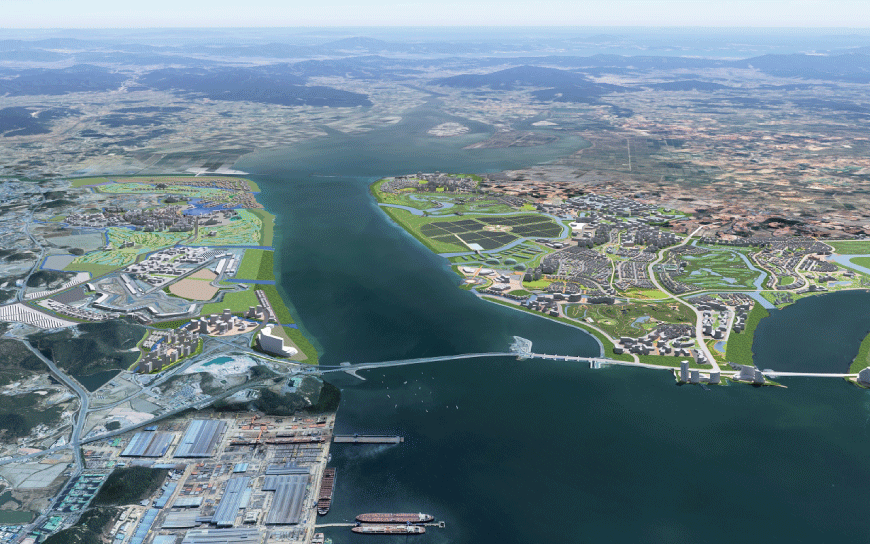
Solaseado Enterprise City, under development in Sani-myeon, Haenam-gun, Jeonnam-Gwangju Special Metropolitan City, is one of Korea’s flagship industrial sites for the energy transition, combining large-scale renewable energy resources with advanced IT infrastructure.
As the AI era drives explosive growth in data center power consumption, the value of industrial sites is rising sharply where clean power is generated and consumed on site—behind the meter—without burdening the Seoul metropolitan power grid. Solaseado is optimized for exactly this environment: over the long term, it is building a power supply base of 9.8 GW, roughly the capacity of nine to ten nuclear reactors. The project is maximizing the region’s power self-sufficiency and building a distributed power system that delivers 100 percent renewable electricity directly to tenant companies.
On the strength of this energy competitiveness, the National AI Computing Center—core infrastructure for the country’s artificial intelligence capabilities—is being built in the Solaseado Data Center Park, with completion targeted for 2028. Starting with this project, which will deploy cutting-edge AI semiconductors, Solaseado is stepping up efforts to attract global IT companies and data centers by combining large-scale advanced industrial land, an abundant industrial water supply and carbon-free power. The Solaseado development aims to generate roughly KRW 3.2 trillion (about USD 2.4 billion) in economic impact and to become home to 100,000 residents as it accelerates toward becoming an eco-friendly, energy self-sufficient city.
Korea’s First Flagship Carbon-Neutral Complex: Gumi National Industrial Complex, Gyeongsangbuk-do
To lead the shift of existing manufacturing complexes toward cleaner energy systems, the government designated the Gumi National Industrial Complex in Gyeongsangbuk-do as the site for its Carbon Neutral Industrial Complex Flagship Model Project and has begun work.
A total of KRW 130 billion (about USD 96 million) will be invested through 2029. Idle sites within the complex—factory rooftops and parking lots on state and public land—will host a 30 MW solar power plant, alongside a 60 MWh energy storage system and a resource recovery ecosystem for the complex. The project is estimated to produce 36 GWh of renewable energy annually over 20 years and to generate KRW 200 billion (about USD 148 million) in social and economic value.
The resulting infrastructure will lower tenant companies’ electricity bills by supplying renewable power generated within the complex at low cost during peak demand hours. At the same time, it will help tenants meet their RE100 targets more easily by cutting greenhouse gas emissions from their manufacturing processes. As a result, Gumi is expected to emerge as Korea’s first carbon-neutral flagship complex, significantly strengthening the export competitiveness of manufacturers exposed to tightening global carbon regulations such as the EU’s CBAM.
Building a Full-Cycle Hydrogen Ecosystem: The Donghae-Samcheok and Pohang Hydrogen-Specialized Complexes
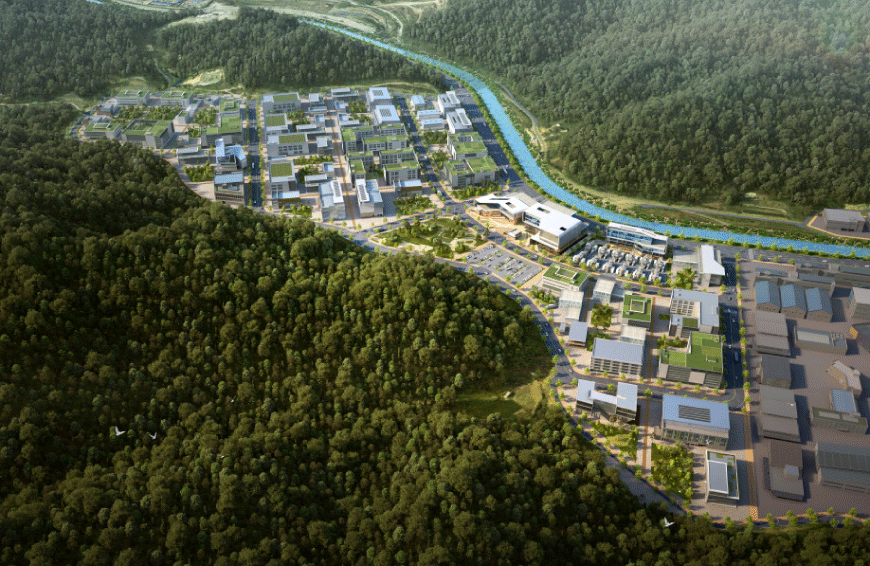
The Ministry of Trade, Industry, and Resources (MOTIR) has designated Donghae and Samcheok in Gangwon-do and Pohang in Gyeongsangbuk-do as Korea’s first hydrogen-specialized complexes—strategic hubs to lead the hydrogen industry, a core pillar of carbon-free energy—and is now developing the sites and recruiting tenant companies, with completion targeted for 2028.
The Donghae-Samcheok complex is dedicated to liquefied hydrogen storage and transport. Under a KRW 320 billion (about USD 237 million) hydrogen storage and transport cluster project, Donghae will provide tenant space and core infrastructure, while Samcheok will host a hydrogen liquefaction plant to ensure a stable supply of liquefied hydrogen.
The Pohang complex is investing KRW 190 billion (about USD 141 million) to build a stationary fuel cell cluster. It is upgrading the domestic fuel cell value chain while also fostering related industries that share materials and components, including fuel cells for mobility and water electrolysis. MOTIR is reviewing a range of administrative and financial incentives for companies moving into the hydrogen-specialized complexes, including priority R&D funding, links to funds that support specialized hydrogen companies, and tax benefits.
Next-Generation Carbon-Free Baseload Meets Advanced Manufacturing: Gyeongju SMR National Industrial Complex, Gyeongsangbuk-do
In response to the growth of advanced industries with enormous power demands, the government is developing the SMR National Industrial Complex in Gyeongju, Gyeongsangbuk-do, at a cost of roughly KRW 300 billion (about USD 222 million), with completion targeted for around 2030.
Small modular reactors take less time to build than large nuclear plants, face fewer siting constraints and can supply stable power 24 hours a day, making them a next-generation baseload source. The Gyeongju complex is a specialized cluster that brings SMR manufacturing, demonstration and export together in one location, and it will focus on attracting the materials, components and equipment companies positioned to lead the global SMR market.
The complex will also link with nearby nuclear R&D infrastructure, including the headquarters of Korea Hydro & Nuclear Power, to provide end-to-end support from technology verification through to domestic sourcing of materials and components.
Sources: Bank of Korea; Ministry of Trade, Industry, and Resources; Korea Industrial Complex Corporation; Haenam County Office; Gyeongsangbuk-do Provincial Government
Written by Korea Industrial Complex Corporation (KICOX)