





- Interview
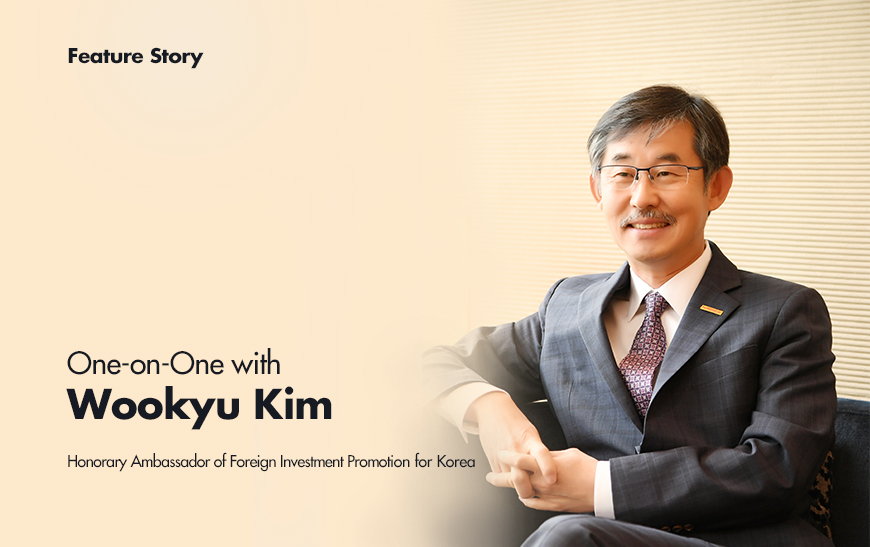
Invest KOREA sat down with Wookyu Kim, Honorary Ambassador of Foreign Investment Promotion, to hear what Korea offers investors and where it still has ground to cover — a view formed by running a foreign-invested company between global headquarters and the local market, and by a seat on the board of the Korean-German Chamber of Commerce and Industry(KGCCI).
The people who know Korea's investment climate best are the companies already operating here. Wookyu Kim hears more of them than most. After 23 years at Merck's German headquarters, he took over the company's Korean operations in 2020, and as a board member of the KGCCI he sees the issues foreign firms in Korea run into again and again. In this interview he speaks less for one company than for the wider foreign business community, weighing what Korea already does well against what it has yet to address.
Please tell us about yourself.
I serve as the Managing Director of Merck Korea, having assumed this role in 2020. I have built a proven track record in the chemical industry across Korea, Germany, and the United States. My extensive experience encompasses various roles, including quality assurance, research and development, product management, and sales leadership, which has equipped me with a unique perspective on the industry's dynamics.
Merck is a leading science and technology company that operates across multiple sectors, including electronics, life science, and healthcare. In 2025, Merck generated impressive sales of EUR 21.1 billion(about KRW 32.9 trillion) in 65 countries, highlighting our global reach and commitment to innovation. Merck Korea, established in 1989, currently operates 12 sites in the country with over 1,800 dedicated employees, all devoted to creating sustainable solutions that make a positive difference in millions of people's lives every day.
Since 2021, I have also been a member of the Board of Directors of the KGCCI, reflecting my commitment to strengthening bilateral relations between Germany and Korea. Through this role, I actively promote collaboration and partnership opportunities that benefit both countries, fostering economic growth and innovation.
What qualities make Korea an attractive investment destination?
Korea's unique market characteristics play a decisive role in driving innovation and serving as a hub for the global market.
First, Korea boasts world-class R&D capabilities and infrastructure in advanced technology sectors such as AI, semiconductors, and biotechnology. The country offers a highly favorable environment for new technology development. Korean companies are known for their rapid commercialization of technology, which not only strengthens their competitiveness in the global market but also positions Korea as an important testing ground for innovation.
Second, the Korean market is characterized by rapidly changing consumer demands and quick market responses, making it an optimal place for multinational companies to test and refine new products and technologies. This agility is a distinct advantage when transferring successful innovations to Europe or other global markets.
Third, Korea's well-developed digital and logistics infrastructure, closely integrated with global supply chains, provides strategic flexibility to efficiently scale innovations internationally or to adjust operations as market circumstances dictate.
In these ways, Korea is recognized as a uniquely strategic and valuable market that promotes innovation, enables swift market reactions, and enhances global readiness. These inherent strengths are critical for multinationals aiming to lead global innovation and facilitate efficient worldwide expansion of their innovations.
What industries or opportunities in Korea are attracting global investors?
Given that Merck's headquarters is in Germany, I have a keen interest in the economic cooperation and industrial development between Germany and Korea. In September of last year, the 'Korea Business Day 2025' forum was held in Frankfurt, Germany, organized by the KGCCI. According to reports from the forum, economic cooperation between Germany and South Korea has made remarkable progress in recent years in advanced industries such as semiconductors, artificial intelligence (AI), robotics, and smart factories. Additionally, cooperation is expanding beyond high-tech sectors into strategic industries such as defense, where areas like drones and missile technologies show growing potential for partnership.
How can Korea become an even more ideal environment for foreign investors?
To make Korea an even more attractive investment destination, continuously refining the regulatory framework can meaningfully enhance the country's competitiveness for global investors. I would like to highlight three broad areas that could foster a more business-friendly ecosystem.
First, Korea could accelerate innovation by further streamlining administrative processes, such as import verification for R&D materials. Aligning Korea's approach with global practices in other major R&D hubs would reduce administrative burdens, shorten lead times, and enable faster execution across high-tech sectors.
Second, in the rapidly growing pharma and biotech sectors, fostering an ecosystem that fully recognizes the value of innovation is key. Policy enhancements that safeguard the stable supply of essential medicines—while ensuring broad patient access—can provide stronger incentives for global healthcare companies to expand their operations and partnerships in Korea.
Third, introducing more flexible incentives for brownfield investments would be highly beneficial. Many global investments today focus on upgrading equipment or expanding capacity within existing facilities. Broadening incentive eligibility to encompass these types of operational expansions would encourage stable, long-term investments and reinforce Korea's position as a reliable base for continuous growth.
As Honorary Ambassador, you speak for Korea as an investment destination. How does Merck Korea's own investment here reflect that message?
Merck Korea has invested more than EUR 220 million(about KRW 340 billion) in Korea and, in 2021, announced an additional EUR 600 million(about KRW 940 billion) investment plan, the 'Level-up' project, to expand semiconductor materials production capacity and reinforce local supply. As part of this initiative, a molybdenum compound manufacturing facility is being localized at our Eumseong plant in Chungcheongbuk-do.
In parallel, we are constructing a Life Science bioprocessing production center in Daejeon, with commercial-scale production targeted for the fourth quarter of 2026. Representing an investment of EUR 300 million(about KRW 470 billion), it is Merck Life Science's largest investment in the Asia-Pacific region, and we plan to create 300 jobs by 2028 as the facility ramps up.
Together, these initiatives reflect Merck Korea's commitment to supporting Korean customers across the full value chain — from electronic materials to the bio industry — through local production, R&D collaboration, and stable supply. We look forward to contributing to national priorities such as regional investment and youth employment, and to the long-term growth of Korea's strategic industries.
By Soyoung Kim
Invest KOREA
Korea Trade-Investment Promotion Agency (KOTRA)