






- Home
- Investment Opportunities
- Latest Information
- Industry Focus
Industry Focus
- Healthcare
- Pharm&Bio
Date
2026.04.09

Growth and Global Competitiveness of Korea’s Bio Industry
The Arrival of the Global Bioeconomy Era
The "bioeconomy" era, characterized by biotechnology-driven economic growth, is well underway. As biotechnology innovation is applied to diverse sectors including healthcare and agrifood, the global bioeconomy is expanding rapidly and is projected to reach up to USD 30 trillion by around 2030. From a supply-side perspective, this growth is primarily catalyzed by biotechnology innovation accelerated by digital transformation, particularly AI. From a demand-side perspective, it is driven by shifts in the market environment due to aging populations and growing demand for personalized medicine. In addition, as technology security grows ever more critical amid a shifting global economic landscape—such as the hegemony competition between the United States and China—the effects of policies actively pursued by countries worldwide to secure bioeconomy leadership are also contributing greatly to global bioeconomy growth.
Rapid Growth of the Korean Bio Industry
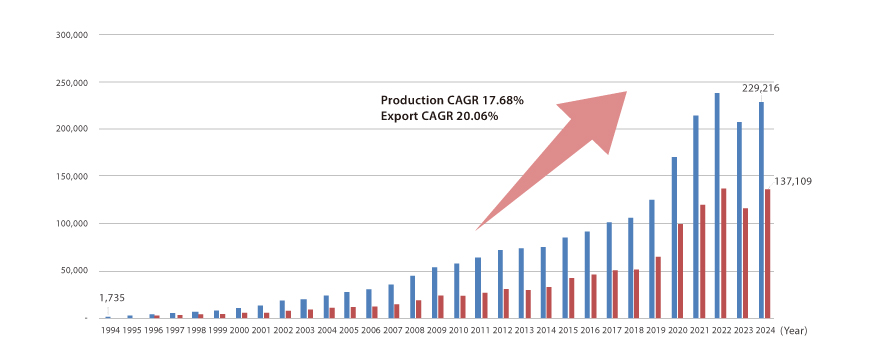
South Korea is also markedly bolstering its competitiveness within the bioeconomy paradigm. According to the 2024 Bio Industry Survey, South Korea’s bio industry production reached approximately KRW 23 trillion (USD 16.79 billion) in 2024, recording a high annual average growth rate of over 17% over the 30 years since 1994. Furthermore, the export volume in 2024 also expanded to approximately KRW 14 trillion (USD 10.22 billion), with an average annual growth rate of over 20 percent since 1994.
Figure 1. Production and Export Volume of Korea’s Bio Industry
Competitiveness in Pharmaceuticals and Medical Devices, which are core sectors of the Korean bio industry, has also been significantly strengthened. According to the Statistical Yearbook of Food and Drug1) by the Ministry of Food and Drug Safety (MFDS), production in Korea’s Pharmaceuticals and Medical Devices sectors grew by an annual average rate of 7.2% and 9.5%, respectively, from 2014 to 2024. The annual average growth rates of their export volumes were 17.4% and 10.2%, respectively, showing an even more rapid increase in their capabilities.
* Source: Ministry of Trade, Industry and Resources (MOTIR) / Korea Bio Association, Domestic Bio Industry Survey (Each Year)
Table 1. Production and Export Volume of Korea’s Pharmaceutical and Medical Device Sectors
(Unit: KRW Trillion)
| 2014 | 2020 | 2024 | 2014~2024 CAGR(%) | ||
|---|---|---|---|---|---|
| Pharmaceuticals | Production | 16.42 | 24.57 | 32.86 | 7.18 |
| Export | 2.54 | 9.96 | 12.67 | 17.43 | |
| Medical Devices | Production | 4.6 | 10.14 | 11.43 | 9.53 |
| Export | 2.71 | 7.83 | 7.17 | 10.22 | |
* Source: Ministry of Food and Drug Safety (MFDS), Statistical Yearbook of Food and Drug (Each Year)
Key Competitiveness of the Korean Bio Industry
The innovation competitiveness of the South Korean bio industry is being markedly strengthened. Diverse entities—encompassing not only biotech and pharmaceutical companies but also major conglomerates—are participating in the bio industry ecosystem to promote the entire lifecycle from R&D to the commercialization of innovative products. Representative biotech companies include Alteogen, LigaChem Bio, Genexine, and ABL Bio, while major pharmaceutical companies such as Yuhan Corp., Hanmi Pharm, and Dong-A ST are actively investing in the development of innovative medicines. As a result, South Korea, which was limited to producing generic drugs in the 1980s, has successfully developed novel drugs since 2000. As of 2025, a total of 41 new drugs have been approved by the MFDS. As of 2025, Korea’s new drug development pipeline accounts for 10% of the global pipeline and 22% of the Asia-Pacific region's pipeline, gaining recognition for its global competitiveness. Korea achieves licensing-out results worth trillions of KRW annually, suggesting that the nation's innovation capabilities have moved beyond basic research and into the commercialization stage.
Korea also possesses world-class competitiveness in biopharmaceutical production capacity, particularly in Contract Manufacturing Organization (CMO) capabilities. As of 2024, out of 73 biosimilar products approved by the U.S. Food and Drug Administration (FDA), 18 were Korean products, representing the second-highest number after the United States (26). Celltrion Inc.’s Remsima IV, one of the FDA-approved products, expanded into the global market and achieved sales of approximately KRW 1.3 trillion (USD 948.9 million) in 2024. Even amidst intensifying global competition in the biopharmaceutical contract manufacturing sector, the competitiveness of South Korean companies—such as Samsung Biologics, Lotte Biologics, and Celltrion—is being recognized worldwide.
Korea also possesses world-class competitiveness in biopharmaceutical production capacity, particularly in Contract Manufacturing Organization (CMO) capabilities. As of 2024, out of 73 biosimilar products approved by the U.S. Food and Drug Administration (FDA), 18 were Korean products, representing the second-highest number after the United States (26). Celltrion Inc.’s Remsima IV, one of the FDA-approved products, expanded into the global market and achieved sales of approximately KRW 1.3 trillion (USD 948.9 million) in 2024. Even amidst intensifying global competition in the biopharmaceutical contract manufacturing sector, the competitiveness of South Korean companies—such as Samsung Biologics, Lotte Biologics, and Celltrion—is being recognized worldwide.

Proactive Policies to Strengthen the Competitiveness of Korean Bio Industry
The Korean government is actively pursuing policies to strengthen the innovation competitiveness of the bio industry. A representative policy is the "Basic Act on the Promotion of Biotechnology," which has been implemented from 1994 to the present. Starting with the "First Framework Plan for the Promotion of Biotechnology (1994–2007)," the "Fourth Framework Plan for the Promotion of Biotechnology (2023–2032)" is currently being executed as of 2026. The Fourth Framework Plan declares a leap toward becoming a leading bioeconomy nation by 2030 through the promotion of digital convergence and strategic R&D investment, while broadly implementing policies to bolster competitiveness across the industrial ecosystem.
Based on proactive government support, R&D investment in the public sector—including universities and research institutes—has expanded significantly. Public R&D investment in Korea increased from USD 1.43 billion in 2007 to USD 6.48 billion in 2023, at an annual average rate of 10 percent, leading to the fortification of innovation competitiveness within the South Korean bio industry.
In addition, the Korean government has supported the strengthening of bio industry competitiveness by establishing regional bio-clusters since the 1990s. The government is actively pursuing strategic investment and regulatory reform policies to activate regional innovation ecosystems, such as Songdo (a cluster for CRO companies), Daejeon (a hub for research institutes), and Osong and Daegu (designated as high-tech medical complexes). Such initiatives stem from the recognition that policy support for organic cooperation, networking, and synergy creation among innovation entities—such as geographically clustered companies, universities, and research institutes—is crucial for the activation of bio-clusters.
Based on proactive government support, the Korean bio industry is participating as a major innovation entity in the global bioeconomy ecosystem. In the bioeconomy ecosystem, where cooperation and linkages between diverse innovation entities are essential at each stage of the value chain (R&D, production, and commercialization), the global status of Korea’s Pharmaceuticals and Biotechnology is expected to rise further.
Based on proactive government support, R&D investment in the public sector—including universities and research institutes—has expanded significantly. Public R&D investment in Korea increased from USD 1.43 billion in 2007 to USD 6.48 billion in 2023, at an annual average rate of 10 percent, leading to the fortification of innovation competitiveness within the South Korean bio industry.
In addition, the Korean government has supported the strengthening of bio industry competitiveness by establishing regional bio-clusters since the 1990s. The government is actively pursuing strategic investment and regulatory reform policies to activate regional innovation ecosystems, such as Songdo (a cluster for CRO companies), Daejeon (a hub for research institutes), and Osong and Daegu (designated as high-tech medical complexes). Such initiatives stem from the recognition that policy support for organic cooperation, networking, and synergy creation among innovation entities—such as geographically clustered companies, universities, and research institutes—is crucial for the activation of bio-clusters.
Based on proactive government support, the Korean bio industry is participating as a major innovation entity in the global bioeconomy ecosystem. In the bioeconomy ecosystem, where cooperation and linkages between diverse innovation entities are essential at each stage of the value chain (R&D, production, and commercialization), the global status of Korea’s Pharmaceuticals and Biotechnology is expected to rise further.
Youn Hee Choi (yhchoi@kiet.re.kr) Senior Research Fellow
Korea Institute for Industrial Economics & Trade (KIET)
1) The results of the Bio Industry Survey by MOTIR focus on statistics regarding innovative products. In contrast, the Statistical Yearbook of Food and Drug by MFDS encompasses a wider scope, covering both innovative and general products, which accounts for the discrepancies in the statistical schedules.