










- Home
- Investment Opportunities
- Latest Information
- Industry Focus
Industry Focus
- Other
- Cultural Content
Date
2026.06.16
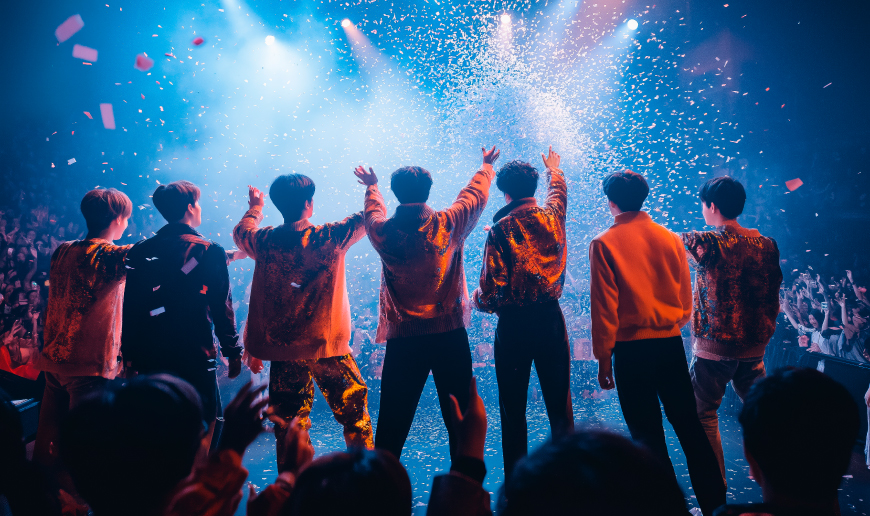
K-POP on the Global Stage
K-POP, which originated as a music genre from a single country, has now established itself as a global cultural force consumed in markets worldwide. According to the “2026 Global Music Report” published by the International Federation of the Phonographic Industry (IFPI), Korea ranked seventh in the global music market as of 20251). Based on the Export Power Score by Luminate, a U.S.-based music analytics firm, Korea ranked fourth globally, following the United States, the United Kingdom, and Canada.2). In fact, according to trade statistics from the Korea Customs Service, album exports in 20253 reached USD 301.74 million, up3)3.4 percent year-on-year.4) These figures are more than numbers; they reflect the growing influence of Korean artists in the global music market. “APT.” by Rosé and Bruno Mars topped the IFPI Global Single Chart in 2025. The chart aggregates global music consumption—physical sales, digital downloads, and audio and video streaming. Notably, this marked the first time a song with non-English lyrics by an artist from outside North America and Europe topped the singles category..5) BTS's fifth studio album, “Arirang,” released in April 2026, debuted at No. 1 on the Billboard 2006). Its track "SWIM" is currently in its fourth consecutive week atop both the Billboard Global 200 and Billboard Global (Excl. U.S.) charts7). Furthermore, performances by Korean artists such as BIGBANG and BLACKPINK at Coachella Valley Music and Arts Festival—one of the world's largest music festivals—demonstrate that K-POP is increasingly embraced as a distinct cultural presence in the global mainstream music market.
Convergence of K-POP and EnterTech
The K-POP industry is rapidly transitioning from a traditional revenue structure focused on album production and live performances toward a new industrial paradigm based on technological convergence. “EnterTech”—a combination of entertainment and technology—has become the core driver of this shift. It is evolving into a business model that expands the fandom-based consumption ecosystem by linking artist intellectual property (IP) with AI, the metaverse, and virtual content.
Galaxy Corporation, G-Dragon's agency, is a leading example of EnterTech's potential, having recently attracted a KRW 100 billion (USD 70 million) pre-IPO investment.8) The company is actively implementing an EnterTech model that combines the IP of its artists, such as G-Dragon and Taemin, with advanced technologies. At G-Dragon's 2025 world tour concert, “Übermensch,” NOTCH technology was applied—using cameras to recognize the artist's face in real time and generate graphics live on stage. The media exhibition “Übermensch,” an experiential entertainment project combining music, technology, and space, was held across 11 cities over approximately one year. It was developed through a collaboration between Galaxy Corporation and Creativemut, using AI, VR, holograms, and Unreal Engine-powered computer graphics.9) In particular, the exhibition deepened immersion through a curated visitor route that linked VR experiences with massive hologram stages. This case demonstrates EnterTech's potential to expand beyond traditional performance tours into global media exhibitions and AI-driven concerts.
Meanwhile, HYBE's fandom platform, Weverse, has grown from a communication space between fans and artists into a multi-revenue platform offering membership-exclusive benefits including albums, merchandise, online concerts, and exclusive content subscriptions. HYBE acquired the AI voice technology firm Supertone and unveiled the AI-based artist project MIDNATT, which renders a single song in six languages and even transforms the vocal timbre.
Virtual idols, in turn, are gaining attention as a new K-POP business model powered by dedicated fandoms. Leveraging motion capture and real-time rendering technology to replicate human movement and emotion, groups such as PLAVE have demonstrated strong commercial viability—PLAVE became the first virtual idol group to sell over one million albums and held a solo concert at Gocheok Sky Dome, Korea’s largest indoor arena.10)
Galaxy Corporation, G-Dragon's agency, is a leading example of EnterTech's potential, having recently attracted a KRW 100 billion (USD 70 million) pre-IPO investment.8) The company is actively implementing an EnterTech model that combines the IP of its artists, such as G-Dragon and Taemin, with advanced technologies. At G-Dragon's 2025 world tour concert, “Übermensch,” NOTCH technology was applied—using cameras to recognize the artist's face in real time and generate graphics live on stage. The media exhibition “Übermensch,” an experiential entertainment project combining music, technology, and space, was held across 11 cities over approximately one year. It was developed through a collaboration between Galaxy Corporation and Creativemut, using AI, VR, holograms, and Unreal Engine-powered computer graphics.9) In particular, the exhibition deepened immersion through a curated visitor route that linked VR experiences with massive hologram stages. This case demonstrates EnterTech's potential to expand beyond traditional performance tours into global media exhibitions and AI-driven concerts.
Meanwhile, HYBE's fandom platform, Weverse, has grown from a communication space between fans and artists into a multi-revenue platform offering membership-exclusive benefits including albums, merchandise, online concerts, and exclusive content subscriptions. HYBE acquired the AI voice technology firm Supertone and unveiled the AI-based artist project MIDNATT, which renders a single song in six languages and even transforms the vocal timbre.
Virtual idols, in turn, are gaining attention as a new K-POP business model powered by dedicated fandoms. Leveraging motion capture and real-time rendering technology to replicate human movement and emotion, groups such as PLAVE have demonstrated strong commercial viability—PLAVE became the first virtual idol group to sell over one million albums and held a solo concert at Gocheok Sky Dome, Korea’s largest indoor arena.10)
Korea's Government Policies to Foster the K-POP Industry
On Oct. 1, 2025, the Korean government launched the Presidential Committee on Popular Culture Exchange to facilitate the global expansion of K-culture, appointing JYP Entertainment's chief creative officer, J.Y. Park, as co-chairman. Beyond simple overseas expansion, this move lays a policy foundation for strengthening K-POP's global competitiveness through public–private collaboration, positioning it as a core cultural industry that drives national growth.
The Ministry of Culture, Sports and Tourism (MCST) has outlined plans to develop K-culture as a core future growth industry11)As part of this, it plans to support K-POP’s global influence, infrastructure, and entry into the global mainstream. First, to expand performance infrastructure, KRW 12 billion (USD 8.4 million) will be allocated in 2026 to upgrade turf and performance equipment at multipurpose sports facilities. In the medium term, the government will support the completion of venues currently under construction, including Seoul Arena and Goyang K-Culture Valley. Over the long term, it plans to build a 50,000-seat domed stadium. The government is also formulating a comprehensive plan to secure performance venues in seven major global cities and to support entry into new markets, including Latin America. Recently, through public–private cooperation, Korea's four leading entertainment agen cies—JYP, HYBE, SM, and YG—have been working to establish a joint venture (JV) and are planning a K-POP festival titled Fanomenon.12)
In April 2026, at a music subcommittee meeting of the Culture and Arts Policy Advisory Committee, the government identified enhancing the sustainability of the music industry as its top priority and launched the Global Expansion Support Project to assist small and medium-sized agencies in entering overseas markets.13) This project provides up to KRW 300 million (USD 210,000) annually for up to three years to help establish a sustainable global business foundation for smaller agencies. Additionally, as part of professional training for popular music practitioners, a KRW 3 billion (USD 2.1 million) Popular Music Industry Talent Development program will build a structured workforce development framework, training approximately 120 specialists.
The Ministry of Culture, Sports and Tourism (MCST) has outlined plans to develop K-culture as a core future growth industry11)As part of this, it plans to support K-POP’s global influence, infrastructure, and entry into the global mainstream. First, to expand performance infrastructure, KRW 12 billion (USD 8.4 million) will be allocated in 2026 to upgrade turf and performance equipment at multipurpose sports facilities. In the medium term, the government will support the completion of venues currently under construction, including Seoul Arena and Goyang K-Culture Valley. Over the long term, it plans to build a 50,000-seat domed stadium. The government is also formulating a comprehensive plan to secure performance venues in seven major global cities and to support entry into new markets, including Latin America. Recently, through public–private cooperation, Korea's four leading entertainment agen cies—JYP, HYBE, SM, and YG—have been working to establish a joint venture (JV) and are planning a K-POP festival titled Fanomenon.12)
In April 2026, at a music subcommittee meeting of the Culture and Arts Policy Advisory Committee, the government identified enhancing the sustainability of the music industry as its top priority and launched the Global Expansion Support Project to assist small and medium-sized agencies in entering overseas markets.13) This project provides up to KRW 300 million (USD 210,000) annually for up to three years to help establish a sustainable global business foundation for smaller agencies. Additionally, as part of professional training for popular music practitioners, a KRW 3 billion (USD 2.1 million) Popular Music Industry Talent Development program will build a structured workforce development framework, training approximately 120 specialists.
K-POP Emerges as a Sustainable Industry Model
Beyond simple music consumption, K-POP is building a distinctive “Fandom Economy” powered by strong fandoms. Through convergence with diverse sectors such as beauty, food, and tourism, this is giving rise to what is now called the “Fan-conomy.” Far from a passing trend, the industry is now drawing global attention for its sophisticated monetization models built on fandom platforms. In its 2024 report, “Music in the Air,” Goldman Sachs identified “Superfans” as a critical growth opportunity for the music industry, citing the fandom platforms of K-POP agencies as a leading global example.14)
As EnterTech drives this evolution, it continues to broaden the fandom-based consumption ecosystem by integrating artist IP with advanced technologies such as AI, the metaverse, and virtual content. Combined with the Korean government's coordinated industry-development policies and public–private global expansion strategies, K-POP is establishing itself not merely as a cultural phenomenon but as a sustainable industry model.
To solidify its standing in global mainstream culture and pioneer new markets, K-POP will need to strengthen technological innovation, creative content production, and its long-term sustainability as an industry.
As EnterTech drives this evolution, it continues to broaden the fandom-based consumption ecosystem by integrating artist IP with advanced technologies such as AI, the metaverse, and virtual content. Combined with the Korean government's coordinated industry-development policies and public–private global expansion strategies, K-POP is establishing itself not merely as a cultural phenomenon but as a sustainable industry model.
To solidify its standing in global mainstream culture and pioneer new markets, K-POP will need to strengthen technological innovation, creative content production, and its long-term sustainability as an industry.
Ji Hye Park (jihye519@kiet.re.kr) 전문연구원
Senior Researcher/Korea Institute for Industrial Economics & Trade (KIET)
1) ifpi(2026), 「GLOBAL GLOBAL MUSIC REPORT」, p.6.
2) https://www.khan.co.kr/article/202502021148001
3) HS Code 8523491040
4) Korea Customs Service, Trade Statistics of Korea, https://tradedata.go.kr/cts/index.do#
5) https://www.ifpi.org/rose-and-bruno-mars-apt-crowned-ifpis-biggest-selling-global-single-of-the-year-2025/
6) https://www.billboard.com/charts/billboard-global-200/(accessed: 2026.4.24.)
7) https://www.billboard.com/music/chart-beat/bts-swim-global-charts-april-25-1236227080/
8) https://www.unicornfactory.co.kr/article/2025121415404514091
9) https://news.mtn.co.kr/news-detail/2026022613353145156
10) https://www.mt.co.kr/society/2025/12/08/2025120315501371527
11) Ministry of Culture, Sports and Tourism, press release(2025.12.16.), “In 2026, ‘K-Culture’ to Be Enjoyed by All Citizens and Embrace the World.”
12) https://www.hani.co.kr/arti/culture/music/1254550.html
13) https://mobile.newsis.com/view/NISX20260423_0003603884
14) Goldman Sachs(2024.5.1.), 「Music in the Air」, p.22~24.
2) https://www.khan.co.kr/article/202502021148001
3) HS Code 8523491040
4) Korea Customs Service, Trade Statistics of Korea, https://tradedata.go.kr/cts/index.do#
5) https://www.ifpi.org/rose-and-bruno-mars-apt-crowned-ifpis-biggest-selling-global-single-of-the-year-2025/
6) https://www.billboard.com/charts/billboard-global-200/(accessed: 2026.4.24.)
7) https://www.billboard.com/music/chart-beat/bts-swim-global-charts-april-25-1236227080/
8) https://www.unicornfactory.co.kr/article/2025121415404514091
9) https://news.mtn.co.kr/news-detail/2026022613353145156
10) https://www.mt.co.kr/society/2025/12/08/2025120315501371527
11) Ministry of Culture, Sports and Tourism, press release(2025.12.16.), “In 2026, ‘K-Culture’ to Be Enjoyed by All Citizens and Embrace the World.”
12) https://www.hani.co.kr/arti/culture/music/1254550.html
13) https://mobile.newsis.com/view/NISX20260423_0003603884
14) Goldman Sachs(2024.5.1.), 「Music in the Air」, p.22~24.