










- Home
- Investment Opportunities
- Latest Information
- Industry Focus
Industry Focus
- Other
- Other
Date
2026.08.27
From Aid Recipient to Supplier
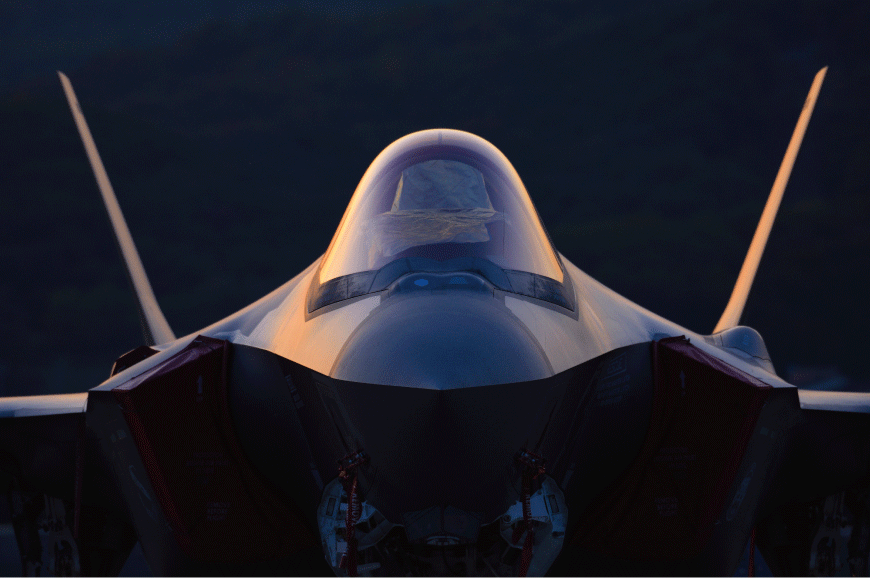
Korea's defense industry entered a clear growth phase as the geopolitical upheaval triggered by the Russia-Ukraine war in 2022 generated a surge in demand that was met by fifty years of accumulated domestic production capacity and comprehensive government support. Western stockpiles emptied, and Korea could refill them.
The demand shock deepened as Washington openly redrew the terms of its security commitments. Amid growing efforts toward security self-reliance, Korea’s defense industry offers strong competitive advantages: cost-effectiveness, rapid delivery, combat-proven platforms continuously upgraded in national service, flexible technology transfers and local production, security cooperation with no political strings attached, and seamless interoperability with Western training and maintenance systems. These factors are leading the industry into an era of unprecedented profitability.
Seventy years ago, Korea relied heavily on foreign military aid. Today, it has emerged as a key pillar in the global defense supply chain. This article examines the current state and key trends of K-Defense during this transformative period.
The demand shock deepened as Washington openly redrew the terms of its security commitments. Amid growing efforts toward security self-reliance, Korea’s defense industry offers strong competitive advantages: cost-effectiveness, rapid delivery, combat-proven platforms continuously upgraded in national service, flexible technology transfers and local production, security cooperation with no political strings attached, and seamless interoperability with Western training and maintenance systems. These factors are leading the industry into an era of unprecedented profitability.
Seventy years ago, Korea relied heavily on foreign military aid. Today, it has emerged as a key pillar in the global defense supply chain. This article examines the current state and key trends of K-Defense during this transformative period.
K-Defense by the Numbers
Korea ranks 13th worldwide for defense budget (2025), 10th for defense revenue (2024), 9th for defense exports (2021-2025 cumulative), and 8th for defense science and technology (2024).
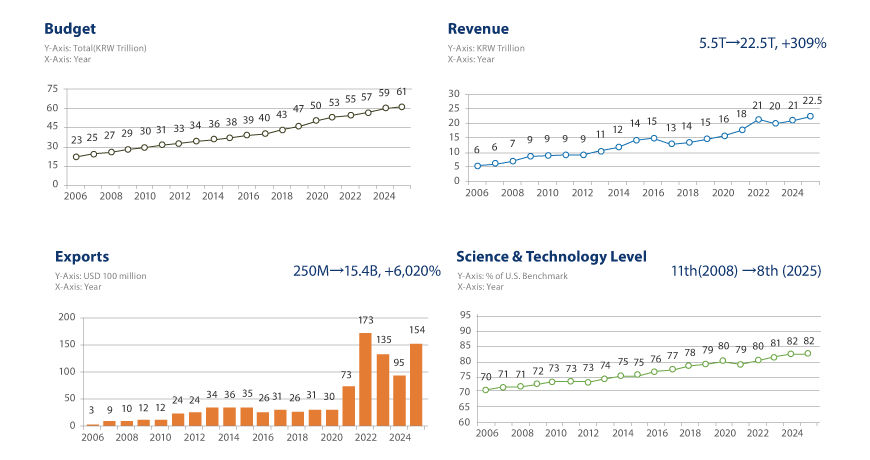
* Source: Ministry of National Defense, Defense Acquisition Program Administration Statistical Yearbook, Korea Research Institute for Defense Technology Planning and Advancement Defense Science and Technology Level Assessment Report, SIPRI
* Defense budget and defense export value are based on 2025 figures, while defense sales and defense science and technology levels are based on 2024 figures. Linear interpolation was applied for unmeasured technology level years.
* Defense budget and defense export value are based on 2025 figures, while defense sales and defense science and technology levels are based on 2024 figures. Linear interpolation was applied for unmeasured technology level years.
Budget.
In national currency, Korea's defense spending surpassed KRW 50 trillion in 2020, cleared KRW 60 trillion in 2025 (KRW 61.59 trillion, +3.6%), and was finalized at KRW 65.86 trillion for 2026 (+7.5%)—accounting for 2.6 percent of GDP.1) Force improvement spending, which buys weapon systems, rose 11.9 percent and drove most of that gain. The money is going into future capability, not routine operations and maintenance.
Revenue.
In its fact sheet The SIPRI Top 100 Arms-producing and Military Services Companies2), the Stockholm International Peace Research Institute (SIPRI) puts the combined revenue of Korean defense firms at KRW 22.5 trillion in 2024, up from KRW 5.5 trillion in 2006. Revenue at the Big Four—Hanwha Aerospace, KAI, Hyundai Rotem and LIG D&A—grew roughly 31 percent, among the fastest rates in any major producer country.
Exports.
The SIPRI Arms Transfers Database ranks Korea fourth worldwide for 2025 alone, with a 6 percent share; on the five-year measure Korea sits ninth. Exports have risen from USD 250 million in 2006, the year the Defense Acquisition Program Administration (DAPA) was founded, to USD 15.4 billion in 2025—some sixtyfold. The climb came in stages: USD 7.3 billion in 2021 on Middle East orders, USD 17.3 billion in 2022 on the Polish contracts, easing to around USD 10 billion across 2023 and 2024, then rebounding to USD 15.4 billion in 2025 (maintaining a four-year average of USD 14 billion). The shape of that curve points to a broadening customer base and a trend sustained over years, not one contract inflating a single year.
Science and technology.
The Korea Research Institute for Defense Technology Planning and Advancement, in its 2024 country-by-country survey(SIPRI)3), places Korea joint-eighth alongside Japan, behind the United States, France, Russia, Germany, the United Kingdom, China and Israel—82 percent of the U.S. benchmark, one place up from ninth in 2021. Artillery ranks fourth worldwide.
General overview
Taken together, these numbers suggest Korea is becoming a load-bearing element of the global defense supply chain rather than simply another exporter. The Export-Import Bank of Korea's research institute expects exports to top USD 27 billion in 20264), and the Big Four's combined order backlog already stands at KRW 130 trillion, providing a solid foundation for sustained performance over the coming years. Meanwhile, ongoing consultations with the Philippines, the UAE and Saudi Arabia continue to create positive momentum.
However, the industry faces headwinds as major nations shift procurement policies toward domestic and regional protectionism. While the U.S. emphasized supply chain resilience and allied cooperation in its 2024 National Defense Industrial Strategy5), actual defense procurement remains tied to the Buy American Act. Similarly, Europe—the primary catalyst for Korea's recent export growth—has introduced the European Defence Industrial Strategy6), setting targets for 2030 that include 50 percent intra-EU procurement, 40 percent collaborative procurement, and 35 percent intra-EU defense trade, while raising the overall target for European-sourced defense purchases from 20 percent today to 50 percent by 2030 and 60 percent by 2035.
However, the industry faces headwinds as major nations shift procurement policies toward domestic and regional protectionism. While the U.S. emphasized supply chain resilience and allied cooperation in its 2024 National Defense Industrial Strategy5), actual defense procurement remains tied to the Buy American Act. Similarly, Europe—the primary catalyst for Korea's recent export growth—has introduced the European Defence Industrial Strategy6), setting targets for 2030 that include 50 percent intra-EU procurement, 40 percent collaborative procurement, and 35 percent intra-EU defense trade, while raising the overall target for European-sourced defense purchases from 20 percent today to 50 percent by 2030 and 60 percent by 2035.
A Virtuous Circle, Now with Evidence
The case for K-Defense rests on more than momentum. The government—the industry's largest customer, its negotiator in government-to-government deals, and the architect of its industrial policy—has put evidence on the table. An analysis of six years of panel data covering 866 defense firms, some 2,400 observations, found that domestic acquisition and industrial capability reinforce each other.7)
The core findings demonstrate that government defense acquisitions provide domestic companies with stable demand and R&D opportunities. This accumulated technical capability enables international expansion, and the resulting export earnings are reinvested back into the domestic acquisition base, creating a self-sustaining virtuous circle.
The export effect arrives in stages over roughly three years. In year one, orders lift factory utilization. In year two, the proceeds go into R&D, facilities and hiring. By year three, the accumulated capability shows up as lower cost ratios and higher operating margins. Firms that invested consistently in R&D also won their next export contract more easily—technology already on the shelf becomes the basis for the next order.
What exports build comes back as domestic strength, and the industry-wide figures mark the turn. Compared to 2022, operating margins across 2023–2024 rose 5.5 percentage points, while cost ratios declined by 2.34 percentage points. In 2025—year three after the 2022 Polish contracts, when those deliveries hit the books—Big Four operating profit is estimated to have climbed from KRW 2.6 trillion to about KRW 4.6 trillion.
The core findings demonstrate that government defense acquisitions provide domestic companies with stable demand and R&D opportunities. This accumulated technical capability enables international expansion, and the resulting export earnings are reinvested back into the domestic acquisition base, creating a self-sustaining virtuous circle.
The export effect arrives in stages over roughly three years. In year one, orders lift factory utilization. In year two, the proceeds go into R&D, facilities and hiring. By year three, the accumulated capability shows up as lower cost ratios and higher operating margins. Firms that invested consistently in R&D also won their next export contract more easily—technology already on the shelf becomes the basis for the next order.
What exports build comes back as domestic strength, and the industry-wide figures mark the turn. Compared to 2022, operating margins across 2023–2024 rose 5.5 percentage points, while cost ratios declined by 2.34 percentage points. In 2025—year three after the 2022 Polish contracts, when those deliveries hit the books—Big Four operating profit is estimated to have climbed from KRW 2.6 trillion to about KRW 4.6 trillion.
The Government's Plan for a Top-Four Position
The administration has set entry into the world's top four defense producers as a national policy task, to be reached through industry promotion and acquisition reform.8)
DAPA has fixed 2030 as the target date, measured against three yardsticks: cutting the time to field advanced weapons to one year from program start; a fourth-place share of global exports across 2026–2030, averaging at least 6 percent; and lifting small and mid-sized firms to 25 percent of industry revenue.
Five policy lines follow.
① An Advanced Defense Capabilities Act (working title) would recast acquisition from planning-driven to application-driven R&D, fielding a minimum viable product within a year of program start.
② Drone and robotics demand now scattered across ministries would be consolidated into whole-of-government purchasing.
③A partnership program between large and smaller firms aims to raise the SME share of revenue from 18 percent to 25 percent by 2030.
④ The focus of K-Defense shifts from legacy platforms such as tanks and self-propelled howitzers toward AI, space and autonomous systems.
⑤ Export strategy extends downstream, securing MRO, upgrades and training as service exports from the moment a contract is signed, packaged alongside Korea's other strategic industries.
DAPA has fixed 2030 as the target date, measured against three yardsticks: cutting the time to field advanced weapons to one year from program start; a fourth-place share of global exports across 2026–2030, averaging at least 6 percent; and lifting small and mid-sized firms to 25 percent of industry revenue.
Five policy lines follow.
① An Advanced Defense Capabilities Act (working title) would recast acquisition from planning-driven to application-driven R&D, fielding a minimum viable product within a year of program start.
② Drone and robotics demand now scattered across ministries would be consolidated into whole-of-government purchasing.
③A partnership program between large and smaller firms aims to raise the SME share of revenue from 18 percent to 25 percent by 2030.
④ The focus of K-Defense shifts from legacy platforms such as tanks and self-propelled howitzers toward AI, space and autonomous systems.
⑤ Export strategy extends downstream, securing MRO, upgrades and training as service exports from the moment a contract is signed, packaged alongside Korea's other strategic industries.
What Comes Next
A country that once depended on foreign arms aid now sells to the world, and while pushback and protective measures from established defense powers are intensifying, this paradoxically testifies to K-Defense's growth into a formidable global peer.
Real problems remain. Roughly 65 percent of Korean defense exports are land systems.9) Aerospace, naval vessels, drones and unmanned and AI-enabled systems carry higher barriers to entry, and that is where the next stage has to happen. Advanced markets in North America and Europe are protected by institutional barriers such as domestic-preference policies (e.g., Buy American Act, Buy European), and breaking into them requires carefully built package deals. Acquiring a weapon system in Korea, meanwhile, still takes about 14 years on average—far too slow for AI and drones, where commercial technology moves far faster.
These are problems the government and industry are already working on. Acquisition timelines are being shortened, long-term capability is being funded, and export support is organized as a single national package, while firms carry their production and export experience into new markets and new technologies. With the government and industry aligning toward this shared goal, K-Defense is well-positioned to maintain its growth trajectory.
Real problems remain. Roughly 65 percent of Korean defense exports are land systems.9) Aerospace, naval vessels, drones and unmanned and AI-enabled systems carry higher barriers to entry, and that is where the next stage has to happen. Advanced markets in North America and Europe are protected by institutional barriers such as domestic-preference policies (e.g., Buy American Act, Buy European), and breaking into them requires carefully built package deals. Acquiring a weapon system in Korea, meanwhile, still takes about 14 years on average—far too slow for AI and drones, where commercial technology moves far faster.
These are problems the government and industry are already working on. Acquisition timelines are being shortened, long-term capability is being funded, and export support is organized as a single national package, while firms carry their production and export experience into new markets and new technologies. With the government and industry aligning toward this shared goal, K-Defense is well-positioned to maintain its growth trajectory.
By Shinheon Kim (kush@kdia.or.kr) Korea Defense Industry Association (KDIA)
1) Korea Defense Industry Association (KDIA), 2026 Defense Industry Trends, 2026.
2) Stockholm International Peace Research Institute (SIPRI), The SIPRI Top 100 Arms-producing and Military Services Companies, SIPRI Fact Sheet, 2020–2024.
3) Korea Research Institute for defense Technology planning and advancement (KRIT), 2024 Survey of Defense Science and Technology Levels by Country, 2024, Ch. 1.
4) The Export-Import Bank of Korea, Overseas Economic Research Institute, Implications of the Recent Middle East Conflict for Korea's Defense Market, 2026.
5) U.S. Department of Defense, National Defense Industrial Strategy, 2024.
6) European Commission, European Defence Industrial Strategy (EDIS), 2024.
7) A New Leap for Acquisition and the Defense Industry, seminar presentation, June 19, 2026, pp. 17–19.
8) DAPA, A New Leap for Acquisition and the Defense Industry, seminar presentation, June 19, 2026, pp. 34–36.
9) EY Hanyoung, K-Defense in the Age of the Defense Gold Rush: In Search of New Goldmines, 2025, p. 26.
2) Stockholm International Peace Research Institute (SIPRI), The SIPRI Top 100 Arms-producing and Military Services Companies, SIPRI Fact Sheet, 2020–2024.
3) Korea Research Institute for defense Technology planning and advancement (KRIT), 2024 Survey of Defense Science and Technology Levels by Country, 2024, Ch. 1.
4) The Export-Import Bank of Korea, Overseas Economic Research Institute, Implications of the Recent Middle East Conflict for Korea's Defense Market, 2026.
5) U.S. Department of Defense, National Defense Industrial Strategy, 2024.
6) European Commission, European Defence Industrial Strategy (EDIS), 2024.
7) A New Leap for Acquisition and the Defense Industry, seminar presentation, June 19, 2026, pp. 17–19.
8) DAPA, A New Leap for Acquisition and the Defense Industry, seminar presentation, June 19, 2026, pp. 34–36.
9) EY Hanyoung, K-Defense in the Age of the Defense Gold Rush: In Search of New Goldmines, 2025, p. 26.
<The opinions expressed in this article are the author’s own and do not reflect the views of KOTRA.>