










- Interview
Date
2026.02.04
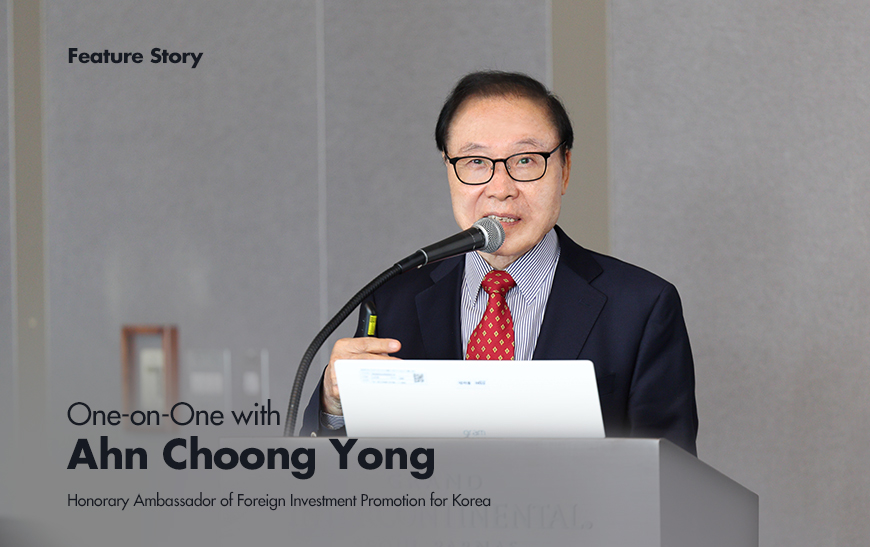
Invest KOREA talks to Ahn Choong Yong, Honorary Ambassador of Foreign Investment Promotion for Korea, to hear about why Korea is a great place to do business and what potential the country offers for investors around the world.
Ahn Choong Yong currently serves as Distinguished Professor of the Graduate School of International Studies (GSIS) at Chung-Ang University. He was the founding dean of GSIS and served as a Professor of Economics at Chung-Ang University for 33 years.
During his sabbaticals, he also held several prominent positions, including President of the Korea Institute for International Economic Policy (2002-2005); Chair of the APEC Economic Committee (2002-2005); Chair of the Board of Choheung Bank; Consultant to the World Bank; and Chief Technical Advisor for UNIDO to Malaysia’s Economic Planning Unit, where he assisted in designing Malaysia’s industrial master plan. Additionally, he served as President of several academic societies in Korea, such as the Korea International Economics Association, the Korean Association of Trade and Industry Studies. Ahn was also a Visiting Professor at the Economic Research Institute of Kyoto University.
Based on his extensive career experience and expertise, Professor Ahn shares his perspectives on why Korea is a great place to do business, and what potential the country offers for investors around the world.
During his sabbaticals, he also held several prominent positions, including President of the Korea Institute for International Economic Policy (2002-2005); Chair of the APEC Economic Committee (2002-2005); Chair of the Board of Choheung Bank; Consultant to the World Bank; and Chief Technical Advisor for UNIDO to Malaysia’s Economic Planning Unit, where he assisted in designing Malaysia’s industrial master plan. Additionally, he served as President of several academic societies in Korea, such as the Korea International Economics Association, the Korean Association of Trade and Industry Studies. Ahn was also a Visiting Professor at the Economic Research Institute of Kyoto University.
Based on his extensive career experience and expertise, Professor Ahn shares his perspectives on why Korea is a great place to do business, and what potential the country offers for investors around the world.
Please tell us about your career experience related to Korean economy and investment.
Following my mandatory retirement from Chung-Ang University (1974–2006), I continued to serve in key national and international roles, including Co-Chair of the Korea-India Strategic Dialogue (2012–2021), Chairman of the Korea Commission for Corporate Partnership (2014–2018), Foreign Investment Ombudsman (2006–2014) appointed by the President of Korea, and Chairman of the Presidential Regulatory Reform Committee (2010–2012). For my services to foreign investors, I received the Bronze Tower Order of Industrial Service Merit from the Korean government, the Order of the Rising Sun, Gold and Silver Star from the Government of Japan, and a plaque of appreciation from the European Chamber of Commerce.
Since receiving my Ph.D. from The Ohio State University, I have published extensively in well-known international academic journals, which have been published by major academic presses, including North-Holland, Cambridge University Press, Oxford University Press, Springer, and Routledge, etc. My most recent book, South Korea and Foreign Direct Investment: Policy Dynamics and Aftercare Ombudsman, was published by Routledge in 2024. Additionally, my co-edited volume with Jagannath Panda, India-Korea Connections in the Indo-Pacific: Minilateralism to Multilateralism, was published by Routledge in May 2025.
Following my mandatory retirement from Chung-Ang University (1974–2006), I continued to serve in key national and international roles, including Co-Chair of the Korea-India Strategic Dialogue (2012–2021), Chairman of the Korea Commission for Corporate Partnership (2014–2018), Foreign Investment Ombudsman (2006–2014) appointed by the President of Korea, and Chairman of the Presidential Regulatory Reform Committee (2010–2012). For my services to foreign investors, I received the Bronze Tower Order of Industrial Service Merit from the Korean government, the Order of the Rising Sun, Gold and Silver Star from the Government of Japan, and a plaque of appreciation from the European Chamber of Commerce.
Since receiving my Ph.D. from The Ohio State University, I have published extensively in well-known international academic journals, which have been published by major academic presses, including North-Holland, Cambridge University Press, Oxford University Press, Springer, and Routledge, etc. My most recent book, South Korea and Foreign Direct Investment: Policy Dynamics and Aftercare Ombudsman, was published by Routledge in 2024. Additionally, my co-edited volume with Jagannath Panda, India-Korea Connections in the Indo-Pacific: Minilateralism to Multilateralism, was published by Routledge in May 2025.
What qualities do you think make Korea an attractive investment destination?
South Korea’s development paradigm has consistently been outward-looking, actively engaging in international trade and cross-border investment while placing unwavering emphasis on education and manpower training. As a result, South Korea has transformed from one of the poorest countries in the early 1960s into a modern, high-income, high-tech economy. The World Bank has described South Korea as a representative case of the East Asian miracle.
Today, the country offers unique business opportunities for foreign investors, underpinned by its world-class high-tech manufacturing industries, including semiconductors, automobiles, shipbuilding, nuclear power plants, frontier bio-industries, and artificial intelligence. These sectors are further supported by the country’s advanced digital infrastructure and sophisticated financial services such as insurance and asset management.
South Korea’s multinational firms are visible across the globe, enabling foreign investors to leverage Korean firms’ existing global networks. Moreover, South Korea is strategically positioned as a supply chain hub for high-tech intermediate goods within East Asia and beyond.
South Korea’s development paradigm has consistently been outward-looking, actively engaging in international trade and cross-border investment while placing unwavering emphasis on education and manpower training. As a result, South Korea has transformed from one of the poorest countries in the early 1960s into a modern, high-income, high-tech economy. The World Bank has described South Korea as a representative case of the East Asian miracle.
Today, the country offers unique business opportunities for foreign investors, underpinned by its world-class high-tech manufacturing industries, including semiconductors, automobiles, shipbuilding, nuclear power plants, frontier bio-industries, and artificial intelligence. These sectors are further supported by the country’s advanced digital infrastructure and sophisticated financial services such as insurance and asset management.
South Korea’s multinational firms are visible across the globe, enabling foreign investors to leverage Korean firms’ existing global networks. Moreover, South Korea is strategically positioned as a supply chain hub for high-tech intermediate goods within East Asia and beyond.
What are the industries or opportunities in Korea that potential global investors are showing interest in?
For multinational companies, South Korea provides a wide range of attractive business opportunities due to its advanced industries and dynamic economy. Through strong public-private partnerships, South Korea aims to maintain technological leadership in sectors such as semiconductors, shipbuilding, nuclear power, rapidly expanding defense industries, bio-industries, digital trade and delivery systems, new materials, and artificial intelligence.
Korea’s aging society also underscores the growing importance of financial activities related to life insurance and asset management as areas of potential interest for foreign investors.
The country continues to seek high-quality R&D activities to reinforce its high-tech sectors. In the era of AI technology, South Korea plans to remain competitive as an AI powerhouse. Although behind global big tech firms such as Nvidia, Google, Microsoft, Apple, Amazon, Alphabet, TSMC, and Tencent, Korea intends to specialize in vertical AI tailored to specific economic applications.
For multinational companies, South Korea provides a wide range of attractive business opportunities due to its advanced industries and dynamic economy. Through strong public-private partnerships, South Korea aims to maintain technological leadership in sectors such as semiconductors, shipbuilding, nuclear power, rapidly expanding defense industries, bio-industries, digital trade and delivery systems, new materials, and artificial intelligence.
Korea’s aging society also underscores the growing importance of financial activities related to life insurance and asset management as areas of potential interest for foreign investors.
The country continues to seek high-quality R&D activities to reinforce its high-tech sectors. In the era of AI technology, South Korea plans to remain competitive as an AI powerhouse. Although behind global big tech firms such as Nvidia, Google, Microsoft, Apple, Amazon, Alphabet, TSMC, and Tencent, Korea intends to specialize in vertical AI tailored to specific economic applications.
What advice would you give investors or companies seeking to do business in Korea?
Multinational companies might analyze South Korea’s industrial and technological development dynamics and government policy directions to pursue competitive and sustainable growth.
In particular, venture startups emerging in the AI era, as well as the shifting investment strategies of South Korea’s major tech firms, warrant detailed analysis. The government is actively promoting venture start-ups in the AI era, while Korea’s business governance continues to align with global best practices. Major Korean tech firms are expanding their business scope through partnerships with global players, gaining renewed momentum within the Pangyo Venture Cluster, Korea’s version of Silicon Valley.
As South Korean firms upgrade their manufacturing capabilities from downstream to upstream in high-tech areas, numerous business opportunities are emerging within its supply chain networks.
Additionally, it is important to examine the available incentive systems, including aftercare services, offered to foreign investors. Meanwhile, Korean popular culture (K-culture) is gaining global prominence, further enhancing its soft power.
Multinational companies might analyze South Korea’s industrial and technological development dynamics and government policy directions to pursue competitive and sustainable growth.
In particular, venture startups emerging in the AI era, as well as the shifting investment strategies of South Korea’s major tech firms, warrant detailed analysis. The government is actively promoting venture start-ups in the AI era, while Korea’s business governance continues to align with global best practices. Major Korean tech firms are expanding their business scope through partnerships with global players, gaining renewed momentum within the Pangyo Venture Cluster, Korea’s version of Silicon Valley.
As South Korean firms upgrade their manufacturing capabilities from downstream to upstream in high-tech areas, numerous business opportunities are emerging within its supply chain networks.
Additionally, it is important to examine the available incentive systems, including aftercare services, offered to foreign investors. Meanwhile, Korean popular culture (K-culture) is gaining global prominence, further enhancing its soft power.
How can Korea be a more ideal investment environment for foreign investors?
To attract high-quality foreign direct investment (FDI), South Korea must build its absorptive capacity by nurturing a highly skilled workforce and world-class researchers, while creating a more flexible labor environment and consistent, transparent legal frameworks.
In particular, local Free Economic Zones (FEZs) must upgrade their investment environment by ensuring the availability of quality labor and researchers. .
To attract high-quality foreign direct investment (FDI), South Korea must build its absorptive capacity by nurturing a highly skilled workforce and world-class researchers, while creating a more flexible labor environment and consistent, transparent legal frameworks.
In particular, local Free Economic Zones (FEZs) must upgrade their investment environment by ensuring the availability of quality labor and researchers. .
What would you like to accomplish during your time as Honorary Ambassador of Foreign Investment Promotion for Korea?
I would like to highlight South Korea’s effective FDI inducement institutions, which incorporate comprehensive aftercare services for foreign investors. The country’s mutually reinforcing mechanism between FDI inducement and aftercare services is unique and has been recognized by the UNCTAD World Investment Report (2024, p. 128), and benchmarked by countries such as Brazil, Kazakhstan, and Russia.
To diffuse the key message of my book, South Korea and Foreign Direct Investment: Policy Dynamics and the Aftercare Ombudsman (published by Routledge 2024), I plan to conduct further international book tours—having already completed tours in Indonesia, Vietnam, Thailand, and Asian Development Bank in Manila, as well as presentations and Q&A sessions at the Foreign Correspondents' Club in Tokyo and hopefully, early this year Malaysia and the US. I also plan to write newspaper articles and participate in international dialogues to share Korea’s efforts to become a leading international business hub.
Additionally, I plan to propose that both RCEP and CPTPP member states incorporate an aftercare services clause in their relatively weak investment chapters, especially RCEP, during future upgrades towards a more open and liberal free trade agreement. .
I would like to highlight South Korea’s effective FDI inducement institutions, which incorporate comprehensive aftercare services for foreign investors. The country’s mutually reinforcing mechanism between FDI inducement and aftercare services is unique and has been recognized by the UNCTAD World Investment Report (2024, p. 128), and benchmarked by countries such as Brazil, Kazakhstan, and Russia.
To diffuse the key message of my book, South Korea and Foreign Direct Investment: Policy Dynamics and the Aftercare Ombudsman (published by Routledge 2024), I plan to conduct further international book tours—having already completed tours in Indonesia, Vietnam, Thailand, and Asian Development Bank in Manila, as well as presentations and Q&A sessions at the Foreign Correspondents' Club in Tokyo and hopefully, early this year Malaysia and the US. I also plan to write newspaper articles and participate in international dialogues to share Korea’s efforts to become a leading international business hub.
Additionally, I plan to propose that both RCEP and CPTPP member states incorporate an aftercare services clause in their relatively weak investment chapters, especially RCEP, during future upgrades towards a more open and liberal free trade agreement. .
By Grace Park
Investment PR Team, Invest KOREA
Korea Trade-Investment Promotion Agency (KOTRA)