










- Interview
Date
2026.04.06
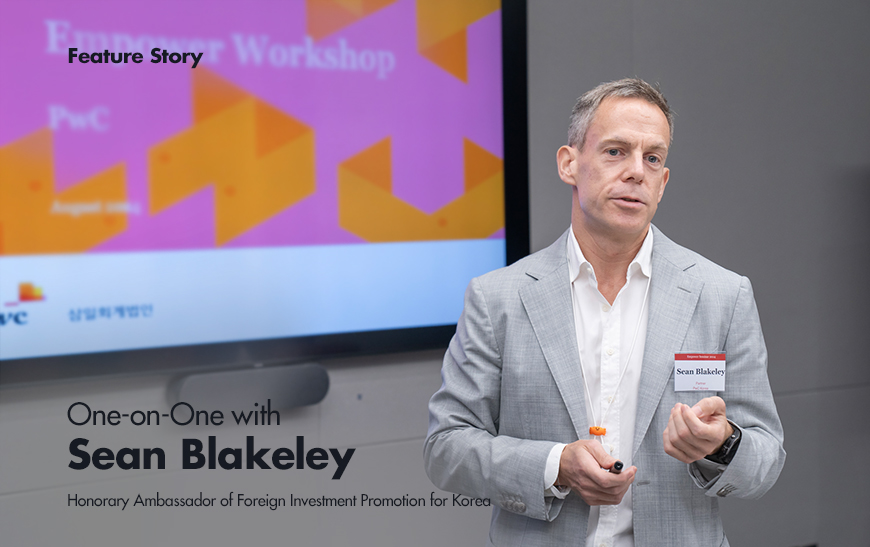
Invest KOREA speaks with Sean Blakeley on what it truly takes to build a business in Korea—and why the opportunity has never been greater.
Few people are better positioned to speak on Korea as a business destination than Sean Blakeley. As a Partner at Samil PwC, he advises multinational corporations navigating the complexities of the Korean market. As Chair of the British Chamber of Commerce in Korea, he represents the voice of the foreign business community. And as Honorary Ambassador for Foreign Investment Promotion for Korea, he works to translate that on-the-ground experience into policy. With over two decades in Korea bridging the public and private divide, Blakeley offers a perspective that is equal parts practitioner, advocate, and insider. Here, he shares what that unique vantage point has taught him about doing business in one of Asia's most dynamic markets.
Please tell us about yourself.
I have spent the last two decades of my life in Korea, starting my journey as a graduate student and progressing to a multifaceted career in trade, consulting, and market development. My primary focus has been on assisting foreign companies in entering and scaling their operations within Korea while simultaneously supporting Korean businesses in their international expansion efforts. Currently, I serve as a Partner at Samil PwC, where I lead the Market Development & Expansion team. Additionally, I am the Chair of the British Chamber of Commerce in Korea and proudly hold the position of Honorary Ambassador for Foreign Investment Promotion for Korea. Throughout my extensive time in Korea, I have honed my ability to balance commercial rigor with cultural and linguistic fluency. I am passionate about crafting practical pathways that transform international interest into long-term, mutually beneficial investments—a goal that resonates deeply across both British and Korean business ethos.
I have spent the last two decades of my life in Korea, starting my journey as a graduate student and progressing to a multifaceted career in trade, consulting, and market development. My primary focus has been on assisting foreign companies in entering and scaling their operations within Korea while simultaneously supporting Korean businesses in their international expansion efforts. Currently, I serve as a Partner at Samil PwC, where I lead the Market Development & Expansion team. Additionally, I am the Chair of the British Chamber of Commerce in Korea and proudly hold the position of Honorary Ambassador for Foreign Investment Promotion for Korea. Throughout my extensive time in Korea, I have honed my ability to balance commercial rigor with cultural and linguistic fluency. I am passionate about crafting practical pathways that transform international interest into long-term, mutually beneficial investments—a goal that resonates deeply across both British and Korean business ethos.
What qualities make Korea an attractive investment destination?
Korea is a unique blend of advanced technological prowess, a highly educated and disciplined workforce, and a consumer base eager to embrace innovation. Its dense and efficient supply chains, supported by a robust manufacturing sector, significantly reduce time-to-market for hardware, deep tech, AI, robotics, and beyond. Moreover, with substantial public funding for research and development alongside corporate commitments to innovation, the acceleration of commercialization is highly feasible. Culturally, Korea boasts a voracious appetite for new services and platforms, particularly visible in gaming, entertainment, and mobile technologies, establishing a receptive local market ripe for scaling globally. This creates not only compelling B2C opportunities but also robust B2B prospects in sectors such as aerospace and defense, where collaboration with global firms is increasingly common, and clean energy transition, which is gaining momentum as the nation prioritizes sustainability. Geographically, Korea serves as a strategic gateway to Northeast Asia, with outstanding logistics and trade connections, while its predictable legal framework and sophisticated financial systems inspire confidence among investors looking to pilot and expand their operations both regionally and internationally.
Korea is a unique blend of advanced technological prowess, a highly educated and disciplined workforce, and a consumer base eager to embrace innovation. Its dense and efficient supply chains, supported by a robust manufacturing sector, significantly reduce time-to-market for hardware, deep tech, AI, robotics, and beyond. Moreover, with substantial public funding for research and development alongside corporate commitments to innovation, the acceleration of commercialization is highly feasible. Culturally, Korea boasts a voracious appetite for new services and platforms, particularly visible in gaming, entertainment, and mobile technologies, establishing a receptive local market ripe for scaling globally. This creates not only compelling B2C opportunities but also robust B2B prospects in sectors such as aerospace and defense, where collaboration with global firms is increasingly common, and clean energy transition, which is gaining momentum as the nation prioritizes sustainability. Geographically, Korea serves as a strategic gateway to Northeast Asia, with outstanding logistics and trade connections, while its predictable legal framework and sophisticated financial systems inspire confidence among investors looking to pilot and expand their operations both regionally and internationally.
What industries or opportunities in Korea attract global investors?
Key industries attracting global investors include semiconductors, advanced materials, and components—areas foundational to technological advancement. The energy storage sector, particularly battery materials for electric vehicles (EVs) and energy storage systems (ESS), is witnessing rapid growth. Korea's strengths in manufacturing and automation make AI, robotics, and industrial automation particularly appealing, while the mobility sector encompassing electrification, advanced driver-assistance systems (ADAS), and component supply chains presents significant cross-border opportunities. The aerospace sector, including aircraft manufacturing and defense technology, offers promising collaboration opportunities with international players and is increasingly attracting investment. Furthermore, the burgeoning culture tech sector, where gaming, media platforms, and intellectual property-driven consumer businesses intersect with global demand, continues to attract high-margin investments. As Korea's aging yet digitally savvy population seeks better healthcare solutions, the healthcare tech and digital therapeutics sectors are emerging rapidly. Additionally, B2B SaaS and cybersecurity, tailored to meet local enterprise needs, round out a diverse portfolio of opportunities, where hardware excellence merges seamlessly with software and services. Lastly, there is substantial potential in clean energy technologies, including solar, wind, and hydrogen, as the country pivots toward sustainable practices.
Key industries attracting global investors include semiconductors, advanced materials, and components—areas foundational to technological advancement. The energy storage sector, particularly battery materials for electric vehicles (EVs) and energy storage systems (ESS), is witnessing rapid growth. Korea's strengths in manufacturing and automation make AI, robotics, and industrial automation particularly appealing, while the mobility sector encompassing electrification, advanced driver-assistance systems (ADAS), and component supply chains presents significant cross-border opportunities. The aerospace sector, including aircraft manufacturing and defense technology, offers promising collaboration opportunities with international players and is increasingly attracting investment. Furthermore, the burgeoning culture tech sector, where gaming, media platforms, and intellectual property-driven consumer businesses intersect with global demand, continues to attract high-margin investments. As Korea's aging yet digitally savvy population seeks better healthcare solutions, the healthcare tech and digital therapeutics sectors are emerging rapidly. Additionally, B2B SaaS and cybersecurity, tailored to meet local enterprise needs, round out a diverse portfolio of opportunities, where hardware excellence merges seamlessly with software and services. Lastly, there is substantial potential in clean energy technologies, including solar, wind, and hydrogen, as the country pivots toward sustainable practices.
What advice would you give investors/companies seeking to do business inKorea?
To achieve success in Korea, it is paramount to prioritise relationship-building. Investing time in cultivating trust with local partners, customers, and advisers is essential. Begin with a focused pilot or proof of concept to demonstrate return on investment (ROI) before scaling up through a hybrid model that fuses local execution with strategic global oversight. Localisation extends beyond language; adjusting your value proposition to align with Korean procurement norms, distribution channels, and corporate decision-making processes is crucial. Engaging strong local leadership early on will accelerate traction. Furthermore, seasoned legal and tax counsel is vital for structuring your entry and protecting intellectual property. Lastly, adopt an iterative approach which comes from learning quickly from pilots and initial market entry initiatives will pave the way for deliberate and informed long-term commitments.
To achieve success in Korea, it is paramount to prioritise relationship-building. Investing time in cultivating trust with local partners, customers, and advisers is essential. Begin with a focused pilot or proof of concept to demonstrate return on investment (ROI) before scaling up through a hybrid model that fuses local execution with strategic global oversight. Localisation extends beyond language; adjusting your value proposition to align with Korean procurement norms, distribution channels, and corporate decision-making processes is crucial. Engaging strong local leadership early on will accelerate traction. Furthermore, seasoned legal and tax counsel is vital for structuring your entry and protecting intellectual property. Lastly, adopt an iterative approach which comes from learning quickly from pilots and initial market entry initiatives will pave the way for deliberate and informed long-term commitments.
How can Korea be a more ideal investment environment for foreign investors?
For Korea to enhance its appeal as an investment destination, several strategic improvements could be made. Simplifying visa processes and talent mobility for specialised hires, alongside streamlining work permit procedures for foreign companies, particularly scale-ups, would be significant steps forward. Increasing regulatory clarity around emerging sectors, such as AI, data, biotechnology, and especially clean energy technologies, is vital. Moreover, harmonising incentive packages across various municipalities can reduce uation times and facilitate investment. While entities like KOTRA do commendable work in supporting investors, establishing a centralised ‘concierge’ service that bundles permit navigation, incentive guidance, and curated partner introductions would considerably ease the entry process for foreign SMEs. Greater transparency in large corporate procurement practices would also open doors for innovative entrants, particularly in aerospace and defense. Collectively, these practical changes would shorten market entry cycles and bolster confidence among investors.
For Korea to enhance its appeal as an investment destination, several strategic improvements could be made. Simplifying visa processes and talent mobility for specialised hires, alongside streamlining work permit procedures for foreign companies, particularly scale-ups, would be significant steps forward. Increasing regulatory clarity around emerging sectors, such as AI, data, biotechnology, and especially clean energy technologies, is vital. Moreover, harmonising incentive packages across various municipalities can reduce uation times and facilitate investment. While entities like KOTRA do commendable work in supporting investors, establishing a centralised ‘concierge’ service that bundles permit navigation, incentive guidance, and curated partner introductions would considerably ease the entry process for foreign SMEs. Greater transparency in large corporate procurement practices would also open doors for innovative entrants, particularly in aerospace and defense. Collectively, these practical changes would shorten market entry cycles and bolster confidence among investors.
What would you like to accomplish during your time as Honorary Ambassador?
As Honorary Ambassador, my ambition is to convert international curiosity into long-term commitments that fortify Korea’s innovation ecosystem. I aim to facilitate the creation of a high-quality pipeline connecting foreign companies—be it start-ups, scale-ups, SMEs, or multinational corporations—with Korean corporates and local partners. Additionally, I am committed to advocating for policy reforms that enhance talent mobility and regulatory certainty, ultimately shortening the time required for foreign companies to scale in Korea. My measures of success will include partnerships forged, transitions from pilot projects to scalable operations, and tangible improvements in the investor experience, all geared toward increasing sustained foreign investment that delivers clear commercial and ecosystem advantages.
As Honorary Ambassador, my ambition is to convert international curiosity into long-term commitments that fortify Korea’s innovation ecosystem. I aim to facilitate the creation of a high-quality pipeline connecting foreign companies—be it start-ups, scale-ups, SMEs, or multinational corporations—with Korean corporates and local partners. Additionally, I am committed to advocating for policy reforms that enhance talent mobility and regulatory certainty, ultimately shortening the time required for foreign companies to scale in Korea. My measures of success will include partnerships forged, transitions from pilot projects to scalable operations, and tangible improvements in the investor experience, all geared toward increasing sustained foreign investment that delivers clear commercial and ecosystem advantages.
By Soyoung Kim
Invest KOREA
Korea Trade-Investment Promotion Agency (KOTRA)