









- Interview
Date
2026.06.10
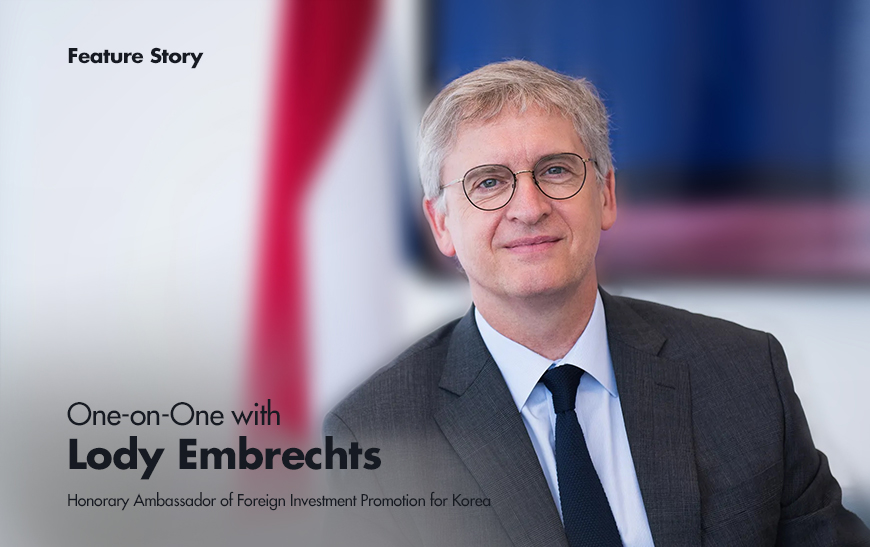
Invest KOREA speaks with Lody Embrechts on the Korea–UAE economic corridor and what makes Korea a compelling destination for foreign investment.
The Korea–UAE economic relationship has entered a new phase—one defined less by single landmark deals than by sustained collaboration across energy, healthcare, defense, and emerging technologies. It is against this backdrop that Invest KOREA spoke with Lody Embrechts—a former Dutch Ambassador to the Republic of Korea who now serves as Senior Advisor to the Ruler of Ras Al Khaimah—about Korea's investment appeal and the long-term trust that anchors meaningful cross-border partnerships.
Please tell us about yourself.
My journey began in the Netherlands, leading to my current role as Senior Advisor for International Relations to His Highness Sheikh Saud bin Saqr Al Qasimi, the Ruler of Ras Al Khaimah in the United Arab Emirates—a rapidly expanding economy with key pillars in manufacturing, tourism, hospitality, distribution, and mining.
My connection to this region was forged through a long diplomatic career with the Kingdom of the Netherlands, during which I was posted to the UAE three times: in Abu Dhabi, as Consul General in Dubai, and subsequently as Ambassador to the UAE. These years allowed me to develop deep-rooted professional and personal relationships, including my enduring association with His Highness Sheikh Saud. After concluding my diplomatic career in 2023, I have been helping to establish an international growth agenda for Ras Al Khaimah.
My diplomatic career has also been defined by my time in Iran, Iraq, Malaysia, and, notably, Korea. In the mid-1990s, I served as Head of the Economic Department at the Dutch Embassy in Seoul, later returning as the Ambassador of the Netherlands to the Republic of Korea and the Democratic People's Republic of Korea. Outside the diplomatic service, I also spent about a year and a half in the private sector, as part of the team that advised and supported the CEO of Shell plc on international relations.
My journey began in the Netherlands, leading to my current role as Senior Advisor for International Relations to His Highness Sheikh Saud bin Saqr Al Qasimi, the Ruler of Ras Al Khaimah in the United Arab Emirates—a rapidly expanding economy with key pillars in manufacturing, tourism, hospitality, distribution, and mining.
My connection to this region was forged through a long diplomatic career with the Kingdom of the Netherlands, during which I was posted to the UAE three times: in Abu Dhabi, as Consul General in Dubai, and subsequently as Ambassador to the UAE. These years allowed me to develop deep-rooted professional and personal relationships, including my enduring association with His Highness Sheikh Saud. After concluding my diplomatic career in 2023, I have been helping to establish an international growth agenda for Ras Al Khaimah.
My diplomatic career has also been defined by my time in Iran, Iraq, Malaysia, and, notably, Korea. In the mid-1990s, I served as Head of the Economic Department at the Dutch Embassy in Seoul, later returning as the Ambassador of the Netherlands to the Republic of Korea and the Democratic People's Republic of Korea. Outside the diplomatic service, I also spent about a year and a half in the private sector, as part of the team that advised and supported the CEO of Shell plc on international relations.
What qualities make Korea an attractive investment destination?
There are several reasons why Korea is such an attractive destination for investment. First, it’s an exceptionally advanced, innovation-driven economy. Korea is a major player in critical sectors such as electronics, semiconductors, batteries, biotechnology, and shipbuilding.
Equally critical is the strength of Korea’s industrial policy and government support. The presence of free economic zones, robust R&D subsidies, and proactive support from institutions such as KOTRA creates a business-friendly environment. Moreover, Korea boasts a world-class workforce; its consistent rankings among the top OECD countries in education and STEM talent are a distinct competitive advantage.
When we consider infrastructure, Korea is unparalleled—not only in terms of physical connectivity via roads, rail, and ports, but also through its digital infrastructure, which ranks among the fastest and most reliable in the world. Finally, Korea offers a high quality of life, characterized by safety and cultural richness, making it a welcoming home for international professionals and their families.
There are several reasons why Korea is such an attractive destination for investment. First, it’s an exceptionally advanced, innovation-driven economy. Korea is a major player in critical sectors such as electronics, semiconductors, batteries, biotechnology, and shipbuilding.
Equally critical is the strength of Korea’s industrial policy and government support. The presence of free economic zones, robust R&D subsidies, and proactive support from institutions such as KOTRA creates a business-friendly environment. Moreover, Korea boasts a world-class workforce; its consistent rankings among the top OECD countries in education and STEM talent are a distinct competitive advantage.
When we consider infrastructure, Korea is unparalleled—not only in terms of physical connectivity via roads, rail, and ports, but also through its digital infrastructure, which ranks among the fastest and most reliable in the world. Finally, Korea offers a high quality of life, characterized by safety and cultural richness, making it a welcoming home for international professionals and their families.
Which sectors are garnering the most interest from global investors?
I would like to highlight the bilateral synergy between Korea and the UAE. Korea’s expertise in AI and semiconductors is world-class, aligning perfectly with the UAE’s strategic goal of becoming a global hub for cloud computing and artificial intelligence. While the UAE possesses the ambition, energy resources, and capital to lead in these areas, it currently seeks the technical ecosystem and operational experience that Korea offers.
The partnership between our two nations is already strong, evidenced by successful collaborations in nuclear energy and defense, and by the presence of institutions like the Seoul National University Hospital.* However, there is significant untapped potential. The UAE’s burgeoning demand for consumer products, health and beauty services, K-content, and innovative start-ups offers a vast landscape for Korean companies to expand their footprint.
* Editor’s Note: The strategic partnership between Korea and the UAE is anchored by major collaborations across three key sectors: healthcare (Seoul National University Hospital has operated the Sheikh Khalifa Specialty Hospital in Ras Al Khaimah since 2014), energy (the Barakah Nuclear Energy Plant, awarded to Korea in 2009), and strategic defense cooperation (a major defense technology export agreement concluded in 2022).
I would like to highlight the bilateral synergy between Korea and the UAE. Korea’s expertise in AI and semiconductors is world-class, aligning perfectly with the UAE’s strategic goal of becoming a global hub for cloud computing and artificial intelligence. While the UAE possesses the ambition, energy resources, and capital to lead in these areas, it currently seeks the technical ecosystem and operational experience that Korea offers.
The partnership between our two nations is already strong, evidenced by successful collaborations in nuclear energy and defense, and by the presence of institutions like the Seoul National University Hospital.* However, there is significant untapped potential. The UAE’s burgeoning demand for consumer products, health and beauty services, K-content, and innovative start-ups offers a vast landscape for Korean companies to expand their footprint.
* Editor’s Note: The strategic partnership between Korea and the UAE is anchored by major collaborations across three key sectors: healthcare (Seoul National University Hospital has operated the Sheikh Khalifa Specialty Hospital in Ras Al Khaimah since 2014), energy (the Barakah Nuclear Energy Plant, awarded to Korea in 2009), and strategic defense cooperation (a major defense technology export agreement concluded in 2022).
What strategic advice would you offer to companies seeking to enter the Korean market?
Success in Korea requires moving beyond theoretical market analysis to a deep understanding of ground-level dynamics. The business environment is fundamentally relationship-driven, and investing time in cultivating authentic, long-term relationships is essential.
Navigating hierarchical structures and understanding local decision-making processes are important. A gradual, consultative approach tends to connect better than aggressive market-entry tactics. Furthermore, Korean consumers are highly sophisticated and hold expectations for premium service. To resonate effectively, companies must invest in localized branding and Korean-language communication. In a society as digitally advanced as Korea’s, a strong digital footprint is no longer optional. Finally, I advise a long-term approach; establishing local leadership and an on-the-ground presence is vital to becoming an integrated part of the local business community.
Success in Korea requires moving beyond theoretical market analysis to a deep understanding of ground-level dynamics. The business environment is fundamentally relationship-driven, and investing time in cultivating authentic, long-term relationships is essential.
Navigating hierarchical structures and understanding local decision-making processes are important. A gradual, consultative approach tends to connect better than aggressive market-entry tactics. Furthermore, Korean consumers are highly sophisticated and hold expectations for premium service. To resonate effectively, companies must invest in localized branding and Korean-language communication. In a society as digitally advanced as Korea’s, a strong digital footprint is no longer optional. Finally, I advise a long-term approach; establishing local leadership and an on-the-ground presence is vital to becoming an integrated part of the local business community.
How can Korea further enhance its appeal to foreign investors?
Like many nations, Korea would benefit from simplifying its regulatory landscape. Implementing a “single-window” approval system, particularly for priority industries, would significantly reduce administrative friction.
Additionally, continued efforts to enhance labor-market flexibility—an area that naturally involves complex policy trade-offs—would further support the adaptability of foreign firms to changing market conditions.
From a policy perspective, long-term, predictable tax incentives would provide foreign investors with the fiscal clarity necessary for substantial, lasting capital commitment. Separately, developing a regional competitiveness strategy—positioning Korea as a Northeast Asian hub for multinational headquarters—would be a powerful incentive, particularly in sectors where Korea holds a clear competitive edge, such as semiconductors and advanced battery technologies.
Like many nations, Korea would benefit from simplifying its regulatory landscape. Implementing a “single-window” approval system, particularly for priority industries, would significantly reduce administrative friction.
Additionally, continued efforts to enhance labor-market flexibility—an area that naturally involves complex policy trade-offs—would further support the adaptability of foreign firms to changing market conditions.
From a policy perspective, long-term, predictable tax incentives would provide foreign investors with the fiscal clarity necessary for substantial, lasting capital commitment. Separately, developing a regional competitiveness strategy—positioning Korea as a Northeast Asian hub for multinational headquarters—would be a powerful incentive, particularly in sectors where Korea holds a clear competitive edge, such as semiconductors and advanced battery technologies.
What would you like to accomplish during your time as Honorary Ambassador?
My aim is to achieve as much as possible—above all, to connect Korean companies with partners in the UAE. I will continue organizing events that help Korean companies discover opportunities in the UAE and engage directly with its leadership. I believe that bringing the right people together is the foundational step for any successful business relationship. This philosophy guided my diplomatic career, informs my current work in Ras Al Khaimah, and remains my guiding principle as I work to strengthen the enduring partnership between Korea and the UAE.
My aim is to achieve as much as possible—above all, to connect Korean companies with partners in the UAE. I will continue organizing events that help Korean companies discover opportunities in the UAE and engage directly with its leadership. I believe that bringing the right people together is the foundational step for any successful business relationship. This philosophy guided my diplomatic career, informs my current work in Ras Al Khaimah, and remains my guiding principle as I work to strengthen the enduring partnership between Korea and the UAE.
By Soyoung Kim
Invest KOREA
Korea Trade-Investment Promotion Agency (KOTRA)