










- Interview
Date
2026.08.27
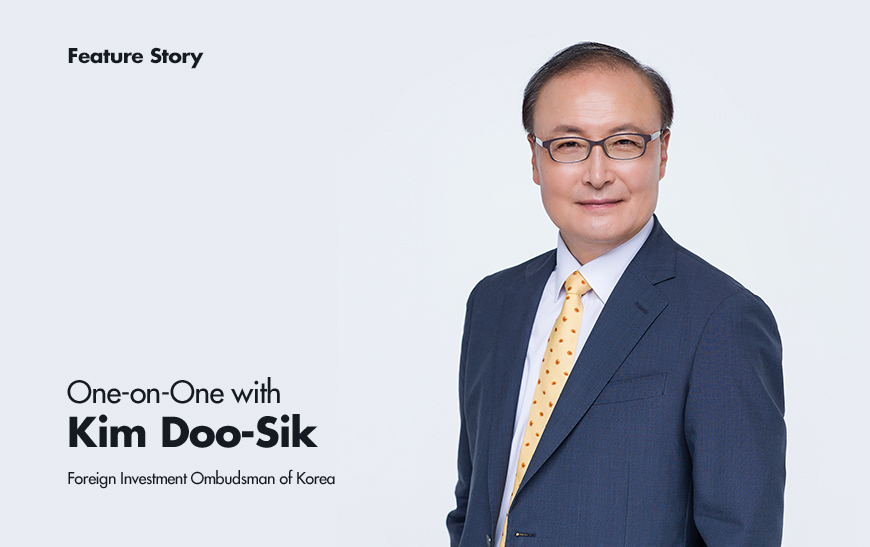
Invest KOREA sat down with Foreign Investment Ombudsman Kim Doo-Sik, who marks his first year in office, to hear his reflections on the past year and his thinking on how to improve Korea's investment environment.
A corporate lawyer for more than 40 years, with a career spanning international trade, arbitration, and M&A, he spoke candidly about the true nature of the regulation he encounters on the ground and the real value of the ombudsman system.
It has been one year since you took office. Could you share your reflections?
Over the past year serving as the foreign investment ombudsman, I have come to realize that the role is highly meaningful and rewarding. Before taking office as the ombudsman, I worked as a private lawyer with one of the biggest law firms in Korea. While working as a private attorney for more than 40 years, I also had a desire to engage in public service. Since my inauguration in June of last year, I have met many foreign investors who clearly appreciated having an ombudsman who listens to their grievances and works on their behalf—and that has made me feel the weight of the public responsibility as the foreign investment ombudsman.
Frankly, when I accepted this position, I didn’t know how my experience as a lawyer would be used in carrying out this job. But I soon realized that my legal experience proved useful. The insights and expertise I had built as a lawyer in international trade, arbitration, M&A, and corporate law helped me quickly figure out the true nature of the problems and difficulties that foreign investors face and find or create reasonable solutions. The ombudsman’s role is not so different from that of a lawyer.
Another thing I have come to realize over the past year is that, when you look beneath the problems foreign investors face, there are many unnecessary regulations. Of course, most of the regulations are unavoidable and serve important public-policy purposes. But there are also a number of regulations that are imposed for trivial or hard-to-justify reasons, and there are sometimes unnecessary constraints that exist merely due to long-standing practices. As it is an important national policy goal to create a business-friendly environment in Korea—for foreign-invested and domestic companies alike—the government needs to examine the current regulatory environment from the investors’ perspective, and to boldly remove those regulations and practices which are not necessarily supported by truly legitimate policy objectives.
Over the past year serving as the foreign investment ombudsman, I have come to realize that the role is highly meaningful and rewarding. Before taking office as the ombudsman, I worked as a private lawyer with one of the biggest law firms in Korea. While working as a private attorney for more than 40 years, I also had a desire to engage in public service. Since my inauguration in June of last year, I have met many foreign investors who clearly appreciated having an ombudsman who listens to their grievances and works on their behalf—and that has made me feel the weight of the public responsibility as the foreign investment ombudsman.
Frankly, when I accepted this position, I didn’t know how my experience as a lawyer would be used in carrying out this job. But I soon realized that my legal experience proved useful. The insights and expertise I had built as a lawyer in international trade, arbitration, M&A, and corporate law helped me quickly figure out the true nature of the problems and difficulties that foreign investors face and find or create reasonable solutions. The ombudsman’s role is not so different from that of a lawyer.
Another thing I have come to realize over the past year is that, when you look beneath the problems foreign investors face, there are many unnecessary regulations. Of course, most of the regulations are unavoidable and serve important public-policy purposes. But there are also a number of regulations that are imposed for trivial or hard-to-justify reasons, and there are sometimes unnecessary constraints that exist merely due to long-standing practices. As it is an important national policy goal to create a business-friendly environment in Korea—for foreign-invested and domestic companies alike—the government needs to examine the current regulatory environment from the investors’ perspective, and to boldly remove those regulations and practices which are not necessarily supported by truly legitimate policy objectives.
For readers encountering it for the first time, could you briefly introduce the Foreign Investment Ombudsman system? It is also recognized internationally as a mechanism for preventing investor-state disputes (ISDs). As someone who has handled ISDs directly, where do you see the system's real value?
The foreign investment ombudsman system was established in 1999 under the Foreign Investment Promotion Act. The system was introduced to create a business environment favorable to foreign investors by resolving regulatory problems and difficulties affecting foreign investors. The ombudsman is appointed directly by the President of the Republic of Korea to give him independent status. The ombudsman is supported by a number of specialists known as “home doctors”—experts with knowledge and experience across all regulatory fields, such as the foreign investment support system, the environment, chemistry, energy, pharmaceuticals and bio, AI and digital, intellectual property, and labor.
The ombudsman is not a government official, but takes on public responsibilities. His role is unique as he works as an intermediary between foreign investors and the government or public institutions, working on the investors' behalf. To resolve problems, the ombudsman has the statutory authority to request cooperation from government ministries and public agencies, and an agency so requested is obliged to cooperate absent special circumstances.
The ombudsman’s service contributes to preventing investor-state disputes (ISDs). The grievances raised by foreign investors, which are not properly addressed, can escalate into investment disputes against the state. The ombudsman, by addressing and resolving those grievances in advance, prevents them from escalating into ISDs. An ISD procedure involves an enormous amount of cost and time for both the suing investor and defending state alike, and in any event significantly erodes investors' confidence in the host country’s investment environment. In this regard, I believe the ombudsman's ISD-prevention function carries great significance.
In a grievance case I recently handled, I was able to prevent a potential investor-state dispute from arising. That case involved a foreign offshore wind company, which had already invested hundreds of millions of dollars in an offshore wind development project in Korea. This company had difficulties in proceeding with the project due to a military agency’s refusal to grant approval. Our office worked with the Ministry of Justice to solve the problem. Eventually, the relevant authorities and the foreign investor came to a settlement.
The foreign investment ombudsman system was established in 1999 under the Foreign Investment Promotion Act. The system was introduced to create a business environment favorable to foreign investors by resolving regulatory problems and difficulties affecting foreign investors. The ombudsman is appointed directly by the President of the Republic of Korea to give him independent status. The ombudsman is supported by a number of specialists known as “home doctors”—experts with knowledge and experience across all regulatory fields, such as the foreign investment support system, the environment, chemistry, energy, pharmaceuticals and bio, AI and digital, intellectual property, and labor.
The ombudsman is not a government official, but takes on public responsibilities. His role is unique as he works as an intermediary between foreign investors and the government or public institutions, working on the investors' behalf. To resolve problems, the ombudsman has the statutory authority to request cooperation from government ministries and public agencies, and an agency so requested is obliged to cooperate absent special circumstances.
The ombudsman’s service contributes to preventing investor-state disputes (ISDs). The grievances raised by foreign investors, which are not properly addressed, can escalate into investment disputes against the state. The ombudsman, by addressing and resolving those grievances in advance, prevents them from escalating into ISDs. An ISD procedure involves an enormous amount of cost and time for both the suing investor and defending state alike, and in any event significantly erodes investors' confidence in the host country’s investment environment. In this regard, I believe the ombudsman's ISD-prevention function carries great significance.
In a grievance case I recently handled, I was able to prevent a potential investor-state dispute from arising. That case involved a foreign offshore wind company, which had already invested hundreds of millions of dollars in an offshore wind development project in Korea. This company had difficulties in proceeding with the project due to a military agency’s refusal to grant approval. Our office worked with the Ministry of Justice to solve the problem. Eventually, the relevant authorities and the foreign investor came to a settlement.
Even as global foreign investment declines, Korea has continued to reach new highs. As important as attracting new investment is keeping investment that has already arrived “in place and reinvesting.” What role does the ombudsman's aftercare play in ensuring these record results are not a one-off number but are sustained?
First, the foreign investment ombudsman is often described as providing “aftercare” services for foreign-invested companies, but that is not quite accurate. The ombudsman helps foreign investors from the very early stage of initial investment; he gets involved when the investor is deciding to invest in Korea. The ombudsman resolves regulatory obstacles faced by the foreign investor and enables the investor to proceed with investment.
Of course, the ombudsman helps a foreign-invested company seeking to reinvest or expand its investment, by providing aftercare services and clearing obstacles that may interfere with that foreign investor’s re-investment.
Having said that, it is more accurate to say that the ombudsman does not only provide “aftercare services,” but also “pre-investment services,” by addressing investment obstacles both before and after the investment. In this sense, I believe that Invest KOREA and the Foreign Investment Ombudsman can work closely together.
First, the foreign investment ombudsman is often described as providing “aftercare” services for foreign-invested companies, but that is not quite accurate. The ombudsman helps foreign investors from the very early stage of initial investment; he gets involved when the investor is deciding to invest in Korea. The ombudsman resolves regulatory obstacles faced by the foreign investor and enables the investor to proceed with investment.
Of course, the ombudsman helps a foreign-invested company seeking to reinvest or expand its investment, by providing aftercare services and clearing obstacles that may interfere with that foreign investor’s re-investment.
Having said that, it is more accurate to say that the ombudsman does not only provide “aftercare services,” but also “pre-investment services,” by addressing investment obstacles both before and after the investment. In this sense, I believe that Invest KOREA and the Foreign Investment Ombudsman can work closely together.
Is there anything you hope to achieve during the remainder of your term?
What I hope for is just one thing: for Korea to become a country of “the world's most transparent and trustworthy business environment” for global investors. To achieve that goal, government departments and units across all ministries should regard themselves as “regulatory improvement bodies” and boldly abolish unnecessary or unreasonable regulations.
At the same time, I bear in mind the importance of the role of the ombudsman in improving the regulatory environment in Korea. We constantly contact foreign investors on the front lines, identifying all the problems and issues that may impede foreign investment. We share them with the relevant ministries or agencies, and seek solutions. For the rest of my term, we will be dedicated to improving business environment for foreign investors. I hope that, through such effort, foreign investors come to have strong confidence in Korea as a favorable destination for their investment.
What I hope for is just one thing: for Korea to become a country of “the world's most transparent and trustworthy business environment” for global investors. To achieve that goal, government departments and units across all ministries should regard themselves as “regulatory improvement bodies” and boldly abolish unnecessary or unreasonable regulations.
At the same time, I bear in mind the importance of the role of the ombudsman in improving the regulatory environment in Korea. We constantly contact foreign investors on the front lines, identifying all the problems and issues that may impede foreign investment. We share them with the relevant ministries or agencies, and seek solutions. For the rest of my term, we will be dedicated to improving business environment for foreign investors. I hope that, through such effort, foreign investors come to have strong confidence in Korea as a favorable destination for their investment.
Finally, do you have a message forforeign investors considering entry into Korea and for our readers?
Korea is an attractive market with advanced industries, infrastructure and a dynamic innovation ecosystem. The Korean government is firmly committed to improving its regulatory environment so that foreign investors can comfortably settle in and grow in the Korean market. The foreign investment ombudsman system was created to realize that commitment. Korea's ombudsman is globally renowned as the most effective grievance resolution system for foreign investors—so much so that many other countries come to learn from us.
We work for foreign investors to alleviate their difficulties in investing and running businesses in Korea. If you as an investor face any regulatory difficulty when deciding to invest or in the course of doing business, please feel free to come to us. We will be good friends you can always rely on.
Korea is an attractive market with advanced industries, infrastructure and a dynamic innovation ecosystem. The Korean government is firmly committed to improving its regulatory environment so that foreign investors can comfortably settle in and grow in the Korean market. The foreign investment ombudsman system was created to realize that commitment. Korea's ombudsman is globally renowned as the most effective grievance resolution system for foreign investors—so much so that many other countries come to learn from us.
We work for foreign investors to alleviate their difficulties in investing and running businesses in Korea. If you as an investor face any regulatory difficulty when deciding to invest or in the course of doing business, please feel free to come to us. We will be good friends you can always rely on.
By Soyoung Kim
Invest KOREA
Korea Trade-Investment Promotion Agency (KOTRA)