






- Home
- Industries
- Industry News
- Industry Focus
Industry Focus
- Energy
- Battery
Date
2025.11.11
Battery Industry Trends
Stable Growth Phase: Where Opportunities and Risks Coexist
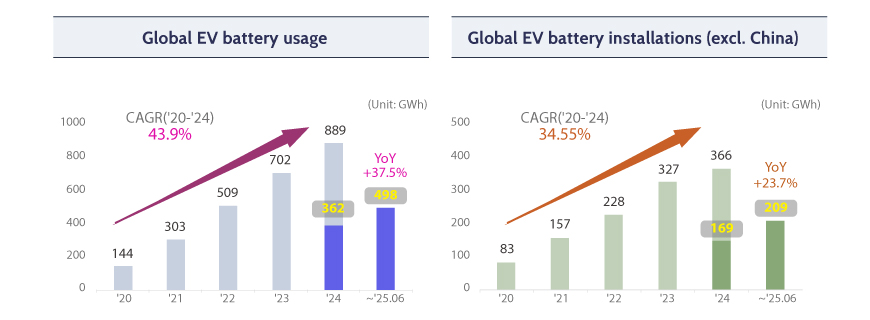
Despite the EV market’s “chasm” and a slowdown in momentum, the battery industry remains a high-growth sector, posting an average annual growth rate above 20%. Although the pace has cooled compared with the past explosive growth, the ongoing shift to wireless for greater convenience in IT devices continues, and the spread of electric vehicles is essential to achieving carbon-neutrality targets. In particular, demand for ESS batteries has surged recently to address the intermittency of renewable energy and to support the build-out of AI data centers, while new markets such as UAM, drones, and robots are also generating demand. There is broad consensus, therefore, that batteries are a highly promising future-defining industry. Recognizing this importance, the new administration included “building an Energy Superhighway” and “a major Energy Transition” among its 123 national policy tasks, raising expectations for a revival in domestic demand.
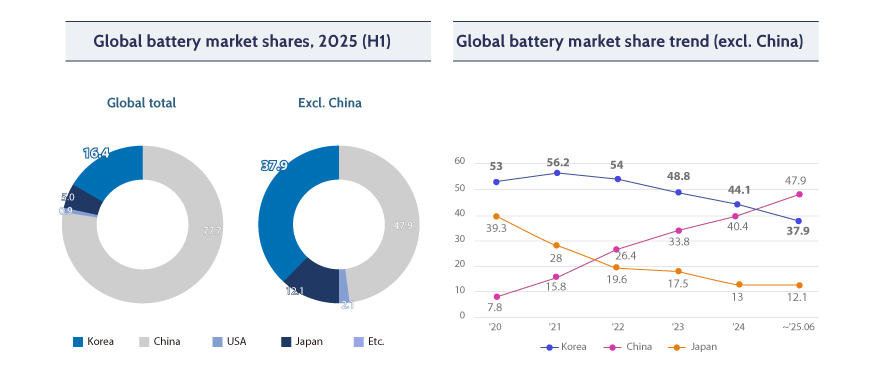
That said, the steady growth of the global battery industry does not, by itself, guarantee a rosy outlook for K-batteries (the Korean battery industry). In the first half of 2025, China’s global market share surpassed 77%, and even in the global market excluding China’s domestic market, China overtook competitors for the first time in Q1 2025—illustrating that China’s rapid expansion is driving growth across the global battery sector. The main reason is that in Europe—formerly the core market—consumer preference has shifted toward mid- to low-priced EVs, leading to greater adoption of lower-cost Chinese-made batteries; consequently, from Q2 2024 onward, market share began to be ceded to China. During this period, China’s share in Europe rose sharply from 47.6% to 60.7%, and price competition has grown even fiercer.
However, the situation is not without its positives. In the U.S. market, Korean battery makers continue to hold a dominant 49% market share, while China’s share has fallen from 18% to 11% - clear evidence that Korea’s early investment strategy is paying off. At the onset of the Trump administration, concerns arose over the potential repeal of Inflation Reduction Act (IRA) subsidies, which many feared could negatively affect Korean firms that had proactively invested in U.S. manufacturing; however, as a result of coordinated government–industry efforts to present the industry’s views, the Advanced Manufacturing Production Credit (AMPC) was preserved intact in the Budget Reconciliation Bill (OBBBA), alleviating uncertainty for the industry and allowing expectations for a stable production environment in the United States.
Global Battery Power Competition
China’s Threat: Massive Government Subsidies, Cost Competitiveness, and Supply Chain Control
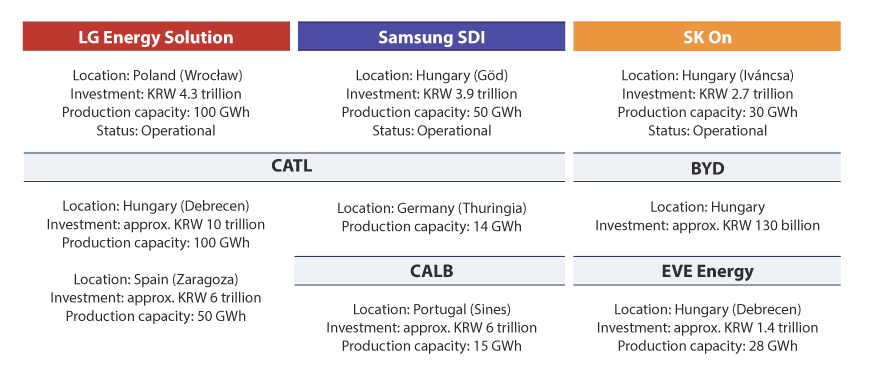
The global battery industry has already transformed into a two-pillar system dominated by South Korea and China, with particularly fierce competition not only in the U.S. and European markets but also across Southeast Asia. China’s relentless rise is backed by an expansive State-led industrial policy centered on its national self-reliance strategy.
| Company | Status |
|---|---|
| LG Energy Solution | Establishing a JV with Hyundai Motor in Indonesia; building a cell plant in Karawang. |
| Samsung SDI | Establishing a second small-battery plant in Seremban, Malaysia, pushing to expand cylindrical-cell production capacity. |
| CATL | Investing in 10 GWh battery-cell manufacturing in Indonesia; expanding investments in upstream battery sectors. |
| BYD | Building EV plants in Thailand and Indonesia, among other locations. |
he most threatening factor is China’s astronomical level of government support for its electric vehicle (EV) and battery industries. Under its “Made in China 2025” initiative, Beijing designated EVs and batteries as one of 10 strategic industrial pillars, with cumulative support estimated at around KRW 320 trillion through 2023. In addition to monetary subsidies, the Chinese central and local governments have actively backed corporate growth with preferential land supply, financing, and other measures. Underpinned by the world’s largest domestic market, China also operated a whitelist system that laid the foundation for explosive growth. As a result, companies such as CATL and BYD have become world leaders, now posing a significant competitive threat to South Korea in global markets.
Future Tasks
Securing Price Competitiveness and Investment Capacity
The most urgent near-term task is to secure price competitiveness against Chinese batteries and materials, - already engaged in a cut-throat price war—while ensuring the capacity to invest for the future in R&D, facility expansion, and talent. Compared with China, Korea’s production environment is structurally disadvantaged by higher electricity tariffs and limited natural resources, and subsidy programs to spur demand for electric vehicles (EVs) and energy storage systems (ESS) are insufficient. As a result, the industry is going through a very difficult period. For Korean battery companies to compete on equal footing in global markets, extraordinary policy support and national R&D investment are required.
By Kim Joonsoo (jskim@k-bia.or.kr)
Manager, Policy Support Team, Korea Battery Industry Association (KBIA)
<The opinions expressed in this article are the author’s own and do not reflect the views of KOTRA.>