










- Home
- Industries
- Industry News
- Industry Focus
Industry Focus
- ICT
- Information and Communication Technologies
Date
2026.02.04

Trends in Korea's AI Industry: Expansion from Platform-Centric Use to Industry-Wide Adoption
As AI usage spreads across industries, Korea's AI industry is gradually expanding its scope of application from the early adoption stage, which was centered on platform and ICT sectors, to various industrial areas including manufacturing. According to the 2024 AI Industry Survey, the Information and Communication sector (46.0%) accounts for the highest proportion of major applied industries for AI products and services, followed by Manufacturing (35.7%) and Public/Administrative/Defense & Social Security Administration (24.8%). This demonstrates that AI utilization is not limited to specific platform industries but is spreading throughout manufacturing and major service industries.
Figure 1. Top 6 Applied Industrial Fields for Representative AI Products & Services (Multiple Responses)
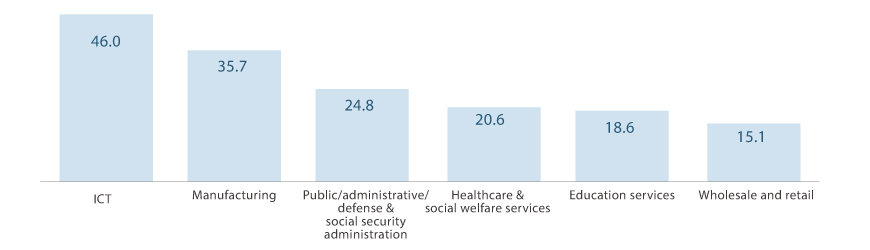
* Source: 2024 AI Industry Survey, Ministry of Science and ICT; Software Policy & Research Institute (SPRi)
The expansion of AI usage by industry implies more than just an increase in application fields; it suggests that the competitive structure of the Korean AI industry is changing. While competition in algorithm performance, model accuracy, and service features centered on platform and ICT companies was prominent in the early stages of AI adoption, recently, in industries with complex operational environments and stakeholders such as manufacturing, healthcare, education, retail, and logistics, the applicability, stability, and operational continuity of AI are emerging as critical factors for judgment.
This indicates that the focus of AI technological competition is shifting beyond single models or individual service performance to operational suitability in actual industrial sites and responsible utilization capabilities. In particular, sectors like manufacturing, healthcare, education, and retail/logistics require safety, reliability, regulatory compliance, and service continuity simultaneously. Thus, the decision to adopt AI is transitioning into a decision-making area where not only technical possibilities but also organizational governance, operational management systems, and risk control capabilities are comprehensively reviewed.
Amidst this trend, the future competitiveness of Korea's AI industry will depend more on the extent to which it secures systematic capabilities to stably design, operate, and manage AI, rather than just technical development capabilities alone. This shows that in the phase of AI expansion, trustworthiness verification systems such as private certifications, standards, and operational criteria are establishing themselves as core infrastructures supporting industrial competitiveness, and establishing an institutional foundation to enhance the maturity of AI utilization across industries is emerging as a significant task.
This indicates that the focus of AI technological competition is shifting beyond single models or individual service performance to operational suitability in actual industrial sites and responsible utilization capabilities. In particular, sectors like manufacturing, healthcare, education, and retail/logistics require safety, reliability, regulatory compliance, and service continuity simultaneously. Thus, the decision to adopt AI is transitioning into a decision-making area where not only technical possibilities but also organizational governance, operational management systems, and risk control capabilities are comprehensively reviewed.
Amidst this trend, the future competitiveness of Korea's AI industry will depend more on the extent to which it secures systematic capabilities to stably design, operate, and manage AI, rather than just technical development capabilities alone. This shows that in the phase of AI expansion, trustworthiness verification systems such as private certifications, standards, and operational criteria are establishing themselves as core infrastructures supporting industrial competitiveness, and establishing an institutional foundation to enhance the maturity of AI utilization across industries is emerging as a significant task.
Changes in AI Policy and Institutional Environment in Response to the Spread of Industrial Application
The policy and institutional environment is also being refined and strengthened beyond development-centric promotion policies to reflect safety, responsibility, and control issues during industrial application and operation processes. This policy direction is confirmed by the fact that the Framework Act on Promotion of Artificial Intelligence Industry and Framework for Building Trustworthiness (hereinafter referred to as the AI Basic Act), which will come into effect on January 22, 2026, includes both the promotion of the AI industry and the establishment of a trust foundation in its legislative purpose.
The AI Basic Act does not adopt a method of uniformly regulating all AI technologies and services but sets management targets centering on areas with high social impact and risk, adopting a structure that combines corporate autonomous management with post-inspection. In other words, rather than restricting AI technology development itself, it focuses on managing risks that may occur during the utilization process in industrial sites and securing accountability.
The AI Basic Act does not adopt a method of uniformly regulating all AI technologies and services but sets management targets centering on areas with high social impact and risk, adopting a structure that combines corporate autonomous management with post-inspection. In other words, rather than restricting AI technology development itself, it focuses on managing risks that may occur during the utilization process in industrial sites and securing accountability.
Table 1. Comparison of AI Basic Act and EU AI Act: Perspective of Korea's AI Industry and Investment
| Category | AI Basic Act | EU AI Act. | Implications for Korea's AI Industry & Investment |
|---|---|---|---|
| Regulatory Philosophy | High-Impact Centered | High-Risk Centered | Management system premised on industrial utilization; scope of management applied differentially according to AI's social impact |
| Scope of Application | Limited Management | Broad Regulation | Environment allowing business structure design while predicting regulatory applicability at the early stage |
| Operator Classification | Single Operator | Role-based Segmentation | Relatively clear institutional structure facilitating response system establishment during early business design |
| Sanction Level | Fixed Cap | Turnover-based | Relatively clear regulatory impact, advantageous for establishing mid-to-long-term business plans |
| Approach Method | Self-regulatory (Ex-post) | Mandatory (Ex-ante) | Approach of refining the management system during operation, rather than focusing on ex-ante obligations |
* Source: Framework Act on Promotion of Artificial Intelligence Industry and Framework for Building Trustworthiness (Act No. 220676, Jan 21, 2025), EU AI Act, Official Journal version of 13 June 2024
In particular, it is designed to require companies developing and operating AI to self-regulate matters such as clarification of responsible entities, data management systems, decision-making structures, and risk response procedures, while the government plays the role of securing industry-wide reliability through minimum standards and supervision. This can be seen as an institutional approach reflecting the reality of expanding AI usage in industries with complex operational environments such as manufacturing, healthcare, and the public sector.
This policy and institutional direction align with the new government's stance on AI promotion. The new government has designated AI as a national strategic industry and presents the creation of an AI ecosystem usable in industrial sites as a policy goal, going beyond simple support for technology development. Accordingly, it is implementing policy measures to strengthen the foundation for utilization, such as industry-specific AI demonstration projects, public-private partnership projects, data and infrastructure construction, and professional workforce training, alongside R&D investment.
Ultimately, the focus of Korea's AI policy is set on creating an environment where AI can be stably designed, operated, and managed, rather than on individual technologies or short-term achievements. This can be interpreted as a result reflecting the perception that in the phase of spreading industrial application, AI policy must go beyond simple promotion and function as an industrial infrastructure providing reliability and predictability.
This policy and institutional direction align with the new government's stance on AI promotion. The new government has designated AI as a national strategic industry and presents the creation of an AI ecosystem usable in industrial sites as a policy goal, going beyond simple support for technology development. Accordingly, it is implementing policy measures to strengthen the foundation for utilization, such as industry-specific AI demonstration projects, public-private partnership projects, data and infrastructure construction, and professional workforce training, alongside R&D investment.
Ultimately, the focus of Korea's AI policy is set on creating an environment where AI can be stably designed, operated, and managed, rather than on individual technologies or short-term achievements. This can be interpreted as a result reflecting the perception that in the phase of spreading industrial application, AI policy must go beyond simple promotion and function as an industrial infrastructure providing reliability and predictability.
Industrial Competitiveness Based on AI Trustworthiness & Governance and Implications for Investment Environment
As examined earlier, Korea's AI policies and systems are moving beyond the promotion stage centered on technology development, focusing on building a foundation of trust for the stable application and operation of AI in industrial sites. These changes in the policy environment do not remain at the institutional level but are gradually influencing companies' methods of AI utilization and management strategies.
Recently, there has been a spreading perception among major companies to view AI not as a short-term means of technology adoption, but as a system that must be continuously operated and managed. Consequently, movements to reorganize AI dedicated organizations, internal control systems, and data/model management standards are continuing, centering on manufacturing, finance, telecommunications, and public-linked industries.
Recently, there has been a spreading perception among major companies to view AI not as a short-term means of technology adoption, but as a system that must be continuously operated and managed. Consequently, movements to reorganize AI dedicated organizations, internal control systems, and data/model management standards are continuing, centering on manufacturing, finance, telecommunications, and public-linked industries.
Table 2. Trends in Korean AI Companies' Response Based on Trustworthiness & Governance
| Category | Major Response Content | Related Company Types |
|---|---|---|
| AI Governance System | Establishment of dedicated AI organizations or management responsibility systems centered on major conglomerates, finance, and telecommunications → Clarification of responsible entities for AI utilization and establishment of decision-making structures | Major manufacturing conglomerates, Telecommunications companies, Major commercial banks |
| Internal Policies and Guidelines | Establishment of internal AI usage guidelines, ethical standards, and data usage principles → Securing prerequisites for participation in projects within public, financial, and regulated industries | Major platform companies, Financial holding company affiliates |
| Data Management | Strengthening of data quality management and training data source/history management systems → Laying the foundation for securing AI performance safety and explainability | Major manufacturing conglomerates, Automakers, Large System Integrators (SI) |
| Model Verification and Operation | Introduction of operational management processes such as model performance monitoring and error/bias checks → Securing trustworthiness and safety in long-term operational environments | Platform companies, Telecommunications companies |
| Utilization of External Verification | Increase in external uation, verification, and certification cases centered on public and financial projects → Expansion of discussions on utilizing third-party verification for AI trustworthiness | Companies participating in public AI projects, Financial AI solution firms |
| Alignment with Business Strategy | Recognizing AI governance not as mere compliance but as a factor for winning business and partnerships → Acting as a risk management factor in global cooperation and investment attraction | SI affiliates of conglomerates, Platform companies |
* Source: Synthesis of public data and press reports regarding AI trustworthiness & governance (Jan 2025 - Dec 2025)
Such corporate-level responses demonstrate that the Korean AI industry is moving beyond the simple technology adoption stage and entering a competition stage premised on the industrial application and continuous operation of AI. This suggests that, in addition to competition in AI model performance, governance and operational management capabilities are emerging as key factors determining industrial competitiveness.
From the perspective of foreign companies and investors, this change means that the Korean market is transitioning from a venue for short-term technological experiments to an environment where institutional standards and corporate operational readiness go hand in hand. The fact that legal and institutional risks that may arise during the process of applying and expanding AI technology in actual industries can be assessed and managed in advance is judged to serve as an important reference factor for reviewing mid-to-long-term business strategies and investment decisions.
Consequently, Korea can be uated as a market that is gradually building an industrial infrastructure based on trustworthiness and governance to stably apply and operate AI across industries, along with AI technological competitiveness. This environment demonstrates Korea's potential to function as a strategic hub for industrial demonstration and expansion in the AI industry where global competition is intensifying.
From the perspective of foreign companies and investors, this change means that the Korean market is transitioning from a venue for short-term technological experiments to an environment where institutional standards and corporate operational readiness go hand in hand. The fact that legal and institutional risks that may arise during the process of applying and expanding AI technology in actual industries can be assessed and managed in advance is judged to serve as an important reference factor for reviewing mid-to-long-term business strategies and investment decisions.
Consequently, Korea can be uated as a market that is gradually building an industrial infrastructure based on trustworthiness and governance to stably apply and operate AI across industries, along with AI technological competitiveness. This environment demonstrates Korea's potential to function as a strategic hub for industrial demonstration and expansion in the AI industry where global competition is intensifying.
Kim Tae-hyung (thkim@aiia.or.kr) Director
Artificial Intelligence Industry Association (AIIA)