










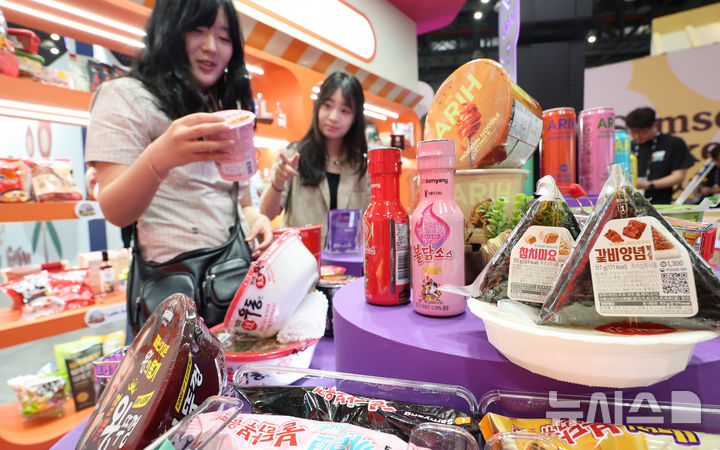
(Goyang = Newsis) Reporter Jeon Jin-hwan – Visitors explore globally popular K-food items at the '2026 My K-Festa' held at KINTEX in Goyang, Gyeonggi Province on the 25th. 2026.06.25. amin2@newsis.com
According to Newsis,
(Sejong = Newsis) Reporter Son Cha-min – 'K-Food+' exports surpassed USD 7 billion in the first half of this year, breaking the previous record for the highest performance. The United States, the number one export destination, alone recorded USD 1 billion, while products such as instant noodles (ramen) and confectionery led the growth trend.
According to the 'First Half of 2026 K-Food+' statistics released by the Ministry of Agriculture, Food and Rural Affairs (MAFRA) on the 5th, export volume for the first half of the year reached USD 7.05 billion. This marks a 4.1 percent increase compared to the same period last year, positioning it as an all-time high.
K-Food+ is a comprehensive concept encompassing the entire agricultural industry, including fresh and processed agri-food products, agricultural materials and machinery, veterinary medicines, and smart farms.
Within this framework, exports in the agri-food sector alone hit USD 5.38 billion, up 5.0 percent year-on-year.
The Middle East (GCC) posted the highest growth rate at 25.2 percent. It was followed by Latin America at 19.5 percent, Europe (EU + UK) at 17.9 percent, North America at 11.0 percent, and the Greater China region at 9.5 percent.
By country, the United States maintained its position as the largest export market for Korean agri-food products. Export volume to the U.S. increased by 11.3 percent compared to a year ago, reaching USD 1.04 billion.
Instant noodles (USD 175.3 million), confectionery (USD 150.1 million), kimchi (USD 24.6 million), and pears (USD 4.4 million) drove the export surge.
China ranked second, generating USD 810 million in export value, which is a 9.4 percent increase year-on-year. Notably, instant noodles alone accounted for USD 217.6 million in exports to China.
By product category, instant noodle exports jumped sharply by 27.9 percent year-on-year to hit USD 940 million. If this trend persists, instant noodle exports are highly expected to break through the USD 1 billion milestone sometime in July—about a month faster than last year.
Confectionery products also logged solid growth at USD 398.8 million (up 7.2 percent), alongside beverages at USD 353.1 million (up 3.1 percent), processed rice foods at USD 149.8 million (up 7.9 percent), and ice cream at USD 70.5 million (up 7.7 percent).
Among fresh agricultural products, strong export performances were tallied for strawberries at USD 60.7 million (up 15.9 percent), grapes at USD 18.1 million (up 27.5 percent), and pears at USD 800,000 (up 62.3 percent).
Kimchi exports reached USD 86 million in the first half of the year. The North American region alone accounted for USD 31 million, representing approximately 40 percent of total kimchi exports.
Meanwhile, the broader agricultural infrastructure and technology sector generated USD 1.66 billion in exports, a 1.4 percent increase compared to a year ago. Major categories including agricultural machinery, fertilizers, and veterinary medicines collectively spearheaded this growth.
Agricultural machinery exports reached USD 706.3 million, climbing 3.2 percent year-on-year. Although purchasing demand for agricultural machinery slowed down slightly in North America due to the increased financial burden of farming expenses, it was offset by an expanded market presence in Europe.
Fertilizer exports soared by 14.4 percent year-on-year to reach USD 254.1 million. This increase was driven by higher export unit prices, as international fertilizer shortages persisted due to export controls by China—a major exporter—and supply chain instabilities stemming from conflicts in the Middle East.
Kim Jeong-wook, Director General of the Agricultural Industry Innovation Policy Bureau at MAFRA, stated, "As K-Food+ export performance demonstrated resilient growth in the first half of the year despite external trade variables, the government will spare no effort in providing support to sustain an even firmer growth trend in the second half."
The official added, "To expand our footprint in primary and promising new markets centered around strategic items, we plan to integrate smart technologies, such as artificial intelligence (AI), across the entire export support ecosystem spanning from production to logistics and marketing. Concurrently, we will expand proactive preparations and support regarding food regulations, certifications, and the distribution of counterfeit K-Food items."
◎ NEWSIS, charming@newsis.com
Copyrights Newsis. All Rights Reserved. Reprint or redistribution without permission is prohibited.
Source Text
Source: Newsis (July 05, 2026)
** This article was translated from Korean.